Command of Evidence questions are among the most (and least) important question types you’ll encounter on the Digital SAT Reading and Writing section.
These questions test your ability to identify, analyze, and use textual as well as quantitative (a.k.a. graphs) evidence.
Like Inference questions, Critical Reading is a crucial ability to have here: Command of Evidence is all about drawing out new information based on existing ones.
In this guide, I will break this question type down as well as show you the exact strategies I used to score a 1600 on the SAT.
What Are Command of Evidence Questions on the Digital SAT?
Command of Evidence questions on the Digital SAT present you with a passage that contains various information and a claim or conclusion.
Your task is to identify a scenario that either supports or undermines this conclusion.
These questions come in two forms:
- Textual: You’ll work with text-based evidence to evaluate the claim. In other words, you only have to deal with the passage.
- Quantitative: These questions include a graph or a table. This type falls outside the scope of this guide and will be covered separately.
In Command of Evidence: Textual, there are actually 2 more subtypes: Illustrate and Support/Undermine. More on those later.
Digital SAT Command of Evidence Question Examples
Here is an Illustrate question, taken from DSAT16, a gamified SAT prep platform I made:
Little Women: Amy March and Social Dynamics
Little Women is an 1868 novel by Louisa May Alcott. In the novel, Alcott characterizes the young Amy March as being keenly aware of social dynamics, suggesting that she derives satisfaction not only from her own presentation but also from the aesthetic appeal and impressiveness of her companion.
Which quotation from Little Women most effectively illustrates the claim?
Select an answer to enable Submit
On the other hand, a Support/Undermine question looks something like this:
Plant VOCs and Herbivore Defense
Plants under herbivore attack often release complex mixtures of volatile organic compounds (VOCs). Traditional ecological thought, supported by early work from researchers like Richard Karban (1983), suggests these airborne signals primarily serve as alarm cues to neighboring plants, priming them for impending threats, or as indirect defenses by attracting predators of the herbivores. However, more recent studies, including those by Jagadeeswaran et al. (2018), have explored the direct role of these VOCs in the attacked plant’s own defense. These investigations suggest that VOCs can directly deter herbivores or even act as antifeedants when reabsorbed by the emitting plant itself. The researchers hypothesize that the primary function of these induced VOCs is to directly reduce further herbivory on the plant that emitted them.
Which finding, if true, would most directly undermine the researchers’ hypothesis?
Select an answer to enable Submit
How to Answer Command of Evidence Questions
#1: The RAPLE Method
The RAPLE method ensures that you are never confused and never have to reread the same passage again and again.
Specifically, it includes 5 steps:
- Read the question
- Analyze the passage
- Predict the answer
- Look at the answer choices
- Eliminate wrong choices and find the correct answer

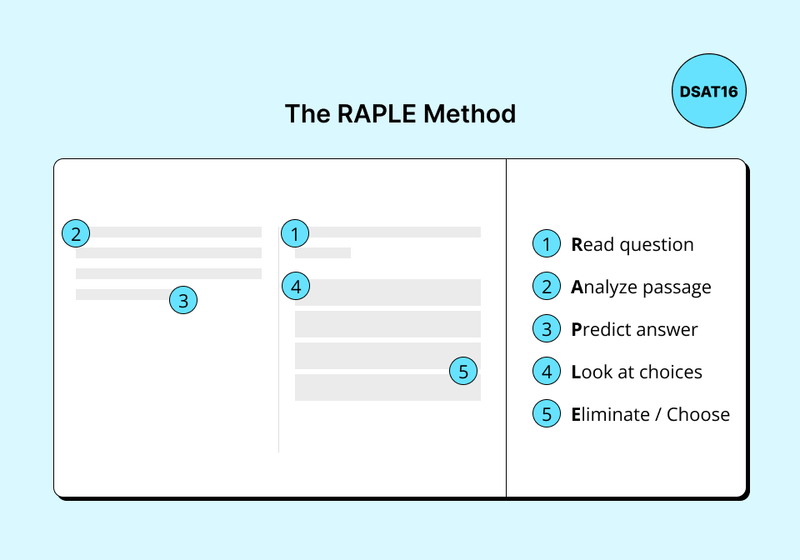
This method can be applied to all other questions on the SAT.
But there are some noticeable traits that you need to consider when dealing with Command of Evidence.
In the “read the question” step, you need to identify the type of question: Illustrate or Support/Undermine?
This decides the tactic for the “analyze” and “predict” steps.
If it is a Support/Undermine question, you have to analyze the whole passage to collect as much data as possible for the reasoning process in the “predict” step.
If it is an Illustrate question, you can skip the whole long passage and only focus on the claim of the passage (usually the last sentence).
Support/Undermine
In Support/Undermine questions, critical thinking is a valuable skill.
This is the same as Inference; however, the logical reasoning is different.
#2: Making an Inference
If you have already prepared for Inference questions, you should be used to 2 goals for the thinking process:
- condensing a passage into math-like expressions
- solving it.
Example
Studies have shown that employees are happier, healthier and more productive when they work in an environment that affords them adequate amounts of natural light. New buildings may be designed with these studies in mind, but many older buildings were not, resulting in spaces that often depend primarily on artificial lighting.
Compress
Information A: Natural light = Good
Information B: New building = Natural light
⇒ Conclusion: Old building = Artificial light = Less natural light
In Inference questions, the process is that you have information A and B from the passage, and you reach a conclusion from those clues. (A, B → ?)
This is rather intuitive because the process of thinking is linear (step-by-step).
But in Command of Evidence questions, you have to follow a non-sequential path:
Clue A and conclusion C will be provided in the passage, and you have to come up with clue B that aligns with clue A and conclusion C. (A, ? → C)
It’s something like this:
Example
Electric cars are becoming increasingly popular because they produce zero tailpipe emissions and help reduce air pollution. Even so, most drivers in the suburbs continue to rely on gas-powered vehicles, making it challenging for them to contribute to these environmental improvements.
Let’s try to get the main information A and conclusion C of the passage, using just a few characters.
Compress
Information A: Electric cars = pollution ↓
Conclusion C: Suburban drivers = environment ↓
Next, we should work with this information critically to find information B.
The passage indicates that “electric cars produce zero tailpipe emissions and help reduce air pollution.”
Hence, we can conclude that electric cars are environmentally friendly.
Further, the claim is that suburban drivers hardly improve the environment.
So, depending on the question type, information B should be a factor that supports or undermines this claim.
Specifically, we can infer information B as:
- For support: A new policy says that environmental benefits require switching to electric cars.
- For undermine: They ride small-engine motorcycles with low fuel consumption, so they generate fewer total emissions.
Inference
Information A: Electric cars reduce pollution.
Conclusion C: Suburban drivers hardly improve the environment.
→ Supporting information B: Policy: good for environment = electric cars
→ Undermining information B: fuel-efficient bikes > electric cars
You can feel that it’s not quite straightforward.
Don’t worry, everyone needs time to master this way of thinking.
Let’s try another example:
Gidra Newsletter’s Influence
As a monthly newsletter formed in 1969 by a group of Asian American students at the University of California, Los Angeles, Gidra helped raise awareness about social and political issues concerning the Asian American community on campus and at large. The newsletter had an expansive reach for a publication of its kind: around 4,000 copies were published each month. A student writing a history paper, however, hypothesizes that Gidra’s influence cannot be measured by the number of newsletters published monthly alone.
Which finding, if true, would most directly support the student’s hypothesis?
Select an answer to enable Submit
#3: Apply It to Support/Undermine Questions
Let’s take a look at this passage:
Ochre Sea Stars and Fresh Water
Ochre sea stars live in tidal pools along the shoreline of the Pacific Ocean. At night, they move to higher shore levels in search of prey. But scientists Corey Garza and Carlos Robles noticed that ochre sea stars stayed at lower levels at night after heavy rains. Garza and Robles hypothesized that a layer of fresh water formed by rainfall was a barrier to the sea stars. To test their hypothesis, the scientists did an experiment. They placed some sea stars in a climbable tank of seawater and other sea stars in a similar tank of seawater with a layer of fresh water on top. Then, the scientists watched the sea stars’ behavior at night.
Which finding from the experiment, if true, would most directly support Garza and Robles’s hypothesis?
Select an answer to enable Submit
Illustrate
Unlike Support/Undermine questions, the Illustrate type does not emphasize your critical thinking ability.
Still, you should have strong reading comprehension and lexical inference skills.
Why?
Because, as the name “Illustrate” suggests, you should find an answer that shows the main idea (or a paraphrased version) of conclusion C.
And most Illustrate questions on the SAT come from old literary works, so you will encounter many unfamiliar words.
Therefore, you can view it as a combination of Words in Context and Central Ideas and Details questions.
#4: Look for Synonyms
As you read above, you need to identify the answer choice that paraphrases the claim.
In other words, the correct answer will contain words that have the same meaning as the claim’s keywords.
So, what’s the trick?
Choose the answer that has synonyms.
Let’s apply this to the following question:
The Land of Enchantment: Escape from Everyday Life
The Land of Enchantment is a 1906 travel book by Lilian Whiting. In the book, which describes the experience of traveling through the southwestern United States by train, Whiting reflects on the escape from everyday life that such a journey provides: ______
Which quotation from The Land of Enchantment most effectively illustrates the claim?
Select an answer to enable Submit
This is kind of easy, right?
Well, watch out for the next tip.
#5: Don’t Be Scared of Hard Words
Many Illustrate questions are about random literary works from the 19th or 20th century.
So, the answer choices will definitely contain old-fashioned English words.
However, your ultimate goal is to choose the answer that matches the idea of the passage’s claim.
Therefore, you just need to sense the meaning of these old-fashioned sentences based on the words you already know.
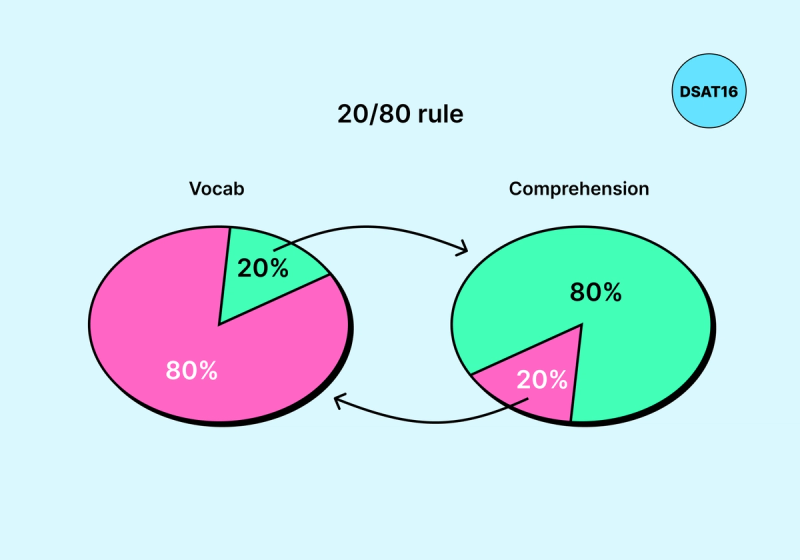
It’s like the 80/20 rule.
You just need to know 20% of the important words to understand 80% of the meaning of the quote.
Let’s try this example:
O Pioneers!: Alexandra’s Connection to Nature
O Pioneers! is a 1913 novel by Willa Cather. In the novel, Cather portrays Alexandra Bergson as having a deep emotional connection to her natural surroundings: ______
Which quotation from O Pioneers! most effectively illustrates the claim?
Select an answer to enable Submit
#6: Read the Last Sentence
As you can see from the Illustrate questions above, you do not need to read every word in the passage to answer.
In fact, nearly all Illustrate questions in the SAT Suite Question Bank and on the real tests follow this pattern.
So, the next time you encounter this type of question, remember to just read the sentence with words like “claim,” “conclusion,” “hypothesis,” and so on.
Knowing this trick, you can stay chill when you encounter this on the day of the real exam.
But why can’t you do this for Support/Undermine?
Unlike Illustrate questions, Support/Undermine questions test your reasoning skill based on information from the passage and the answers.
Therefore, in Support/Undermine, do not just focus on the claim of the passage.
Try to collect as much information as possible to support your critical thinking process. It is necessary to see the overall view.
#7: A Common Trap for Both Types
This is a trap that a lot of students fall for.
Knowing how to avoid it can boost your number of correct answers in Command of Evidence questions.
So, what’s this trap?
An answer choice might appear correct, but it mentions information beyond the scope of the passage.
So, pay extra attention to the scope of the conclusion.
Let’s try this example:
Optimal Foraging Theory and Lunar Intensity
Optimal foraging theory (OFT) holds that animals’ foraging behaviors reflect cost-benefit trade-offs that vary by species and with dynamic ecological circumstances. One such circumstance is lunar intensity, which Mary V. Price and colleagues found to be negatively associated with foraging by white-throated woodrats but Eduardo Fernández-Duque and colleagues found to be positively associated with foraging by Azara’s night monkeys. This discrepancy is explicable in terms of OFT: the monkeys’ greater reliance on vision means that higher lunar intensity benefits them more than it benefits the woodrats.
Which choice best describes the finding made by Fernández-Duque and colleagues, as presented in the text?
Select an answer to enable Submit
Conclusion
Thanks to this guide, you’re now equipped with the skills to deal with these questions with confidence, no matter how tricky the passages get.
Although these methods might seem easy to understand, you need to practice regularly to fully master them.
Ready to put these strategies into action? Head over to DSAT16 for some Command of Evidence practice questions.