Inferences are one of the hardest questions in the verbal section of the digital SAT.
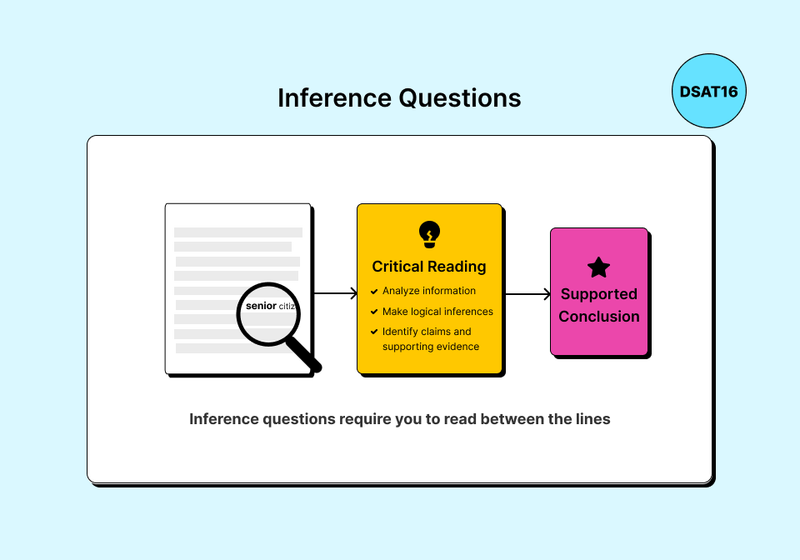
This is because, unlike most reading questions, Inference questions require you to do some logical thinking (the only other exception is Command of Evidence).

In this post, I will show you the exact strategies I took to master this section of the SAT.
What are Inference Questions in the Digital SAT?
Inference questions consist of a passage providing various information about a topic. The passage is unfinished: there is a blank at the end.
Your job is to use the information in the passage and find the statement that most logically completes the text.
Sat Inference Questions Example
An Inference question looks something like this:
Digital SAT Inference Example (Easy)
The iconic limestone bust of Nefertiti, discovered in 1912, presents a vision of idealized beauty and regal composure. However, Egyptologist Erika Feucht notes that other contemporary depictions of Nefertiti, particularly reliefs found at Amarna, show less symmetrical features and signs of age. These alternative representations, unlike the famous bust which was found in the workshop of the sculptor Thutmose, likely served different purposes and audiences than the workshop model. The contrast between the idealized bust and the more realistic reliefs suggests that ______
Which choice most logically completes the text?
Select an answer to enable Submit
P/S: These questions are taken from DSAT16, an SAT prep platform I made. If you want more questions like them, please check them out!
How Many Inference Questions are there in an SAT Test?
There are no official number of inference questions in an SAT test.
However, based on past digital SAT tests as well as Bluebook practice tests, I can say that there are 1-3 Inference questions per module on average.
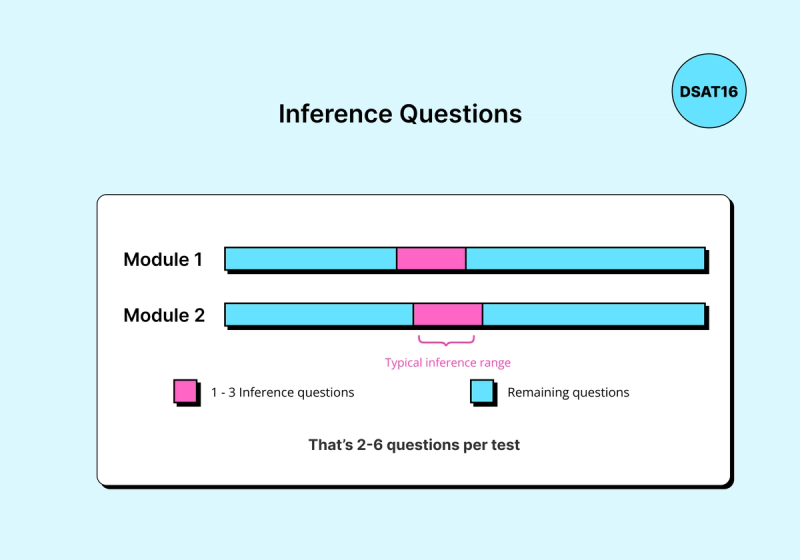
That’s 2-6 questions per test.
These questions will be placed right in the middle of the module (i.e. right before the writing section).
One Tip for Inference Questions: Skip It
When I studied for the SAT in 2023, I immediately dived into Information and Ideas questions.
These are the only questions that require logical thinking. Since, I was good at that, those questions felt interesting to dissect.
After a few weeks of studying, I succeeded.
However, my score only improved by 30 points.
That’s a decent jump, but not good enough for over a month of studying.
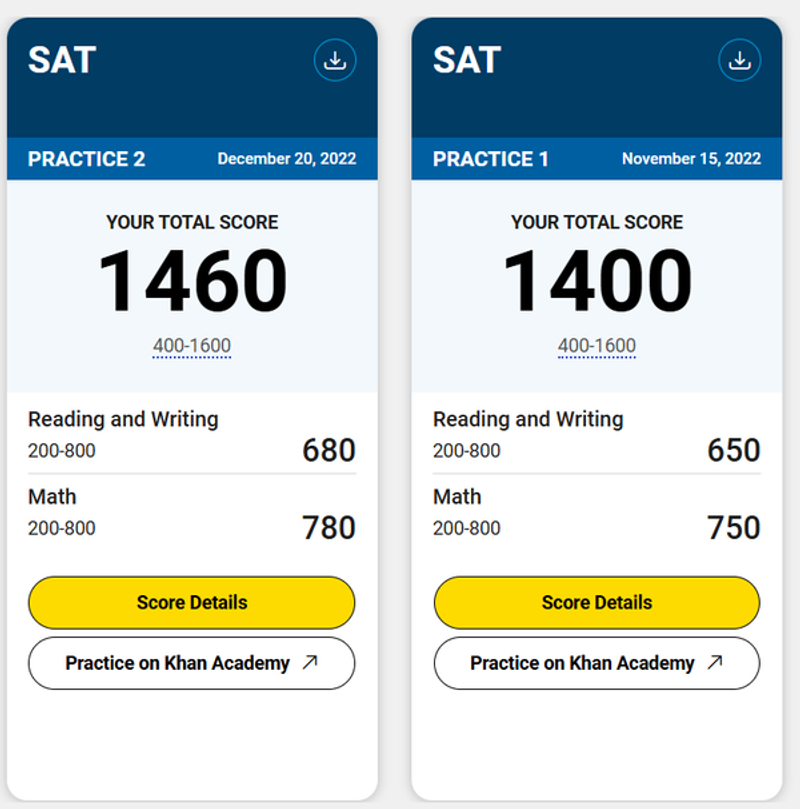
After doing some research to implement the grading function for DSAT16’s full-length practice test, I found out why.
Under the hood, the digital SAT uses Item response theory (IRT) to score the test.
Which means that, counterintuitively, harder questions worth less points than easier ones.
For example, if you answer a hard question correctly, you will only get maybe 10 points, whereas you would get 30 points if you get an easy question right.
To demonstrate this, Applerouth also analyzed the digital SAT test and found that the questions with the greatest weighting are easy questions and Student-Produced Responses (in Math modules).
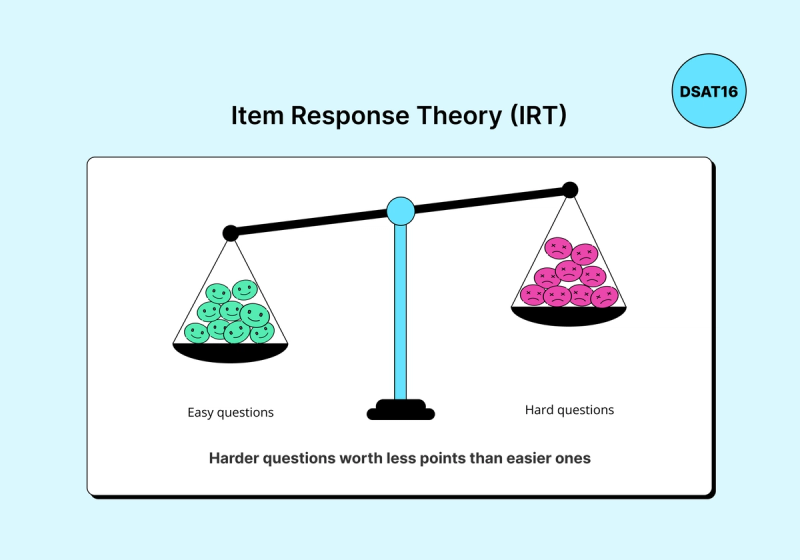
Since Inferences (or Information and Idea questions in general) are among the hardest questions, they don’t contribute to your score as much.
What should you do with this information?
Unless you are aiming for a 700+ Verbal, you are better off skipping these questions (after randomly guess (D) of course).
Use those precious time to do other questions, or even double check the easier ones.
But if you are aiming for that 800 Verbal, you must know how to make an inference.
Join my email list to get notified when I put out blogs like these!
How to Answer Inference Questions
#1: The RAPLE method
Like with almost any other Reading questions, you should follow this 5-step framework:
- Read the question.
- Read the passage.
- Summarize the key information (rephrase it in your own words if necessary).
- Predict the answer by making various inferences from the given information.
- Check the answer and select the one that matches.
We’ll go deeper into the whole process in a second. However, notice how we are already making an inference before looking at the answer choices.
When you look at the answer choices first, your brain gets influenced by what's written there.
You start second-guessing yourself.
But when you predict the answer beforehand, you know exactly what you're looking for.
If an answer choice matches your prediction almost perfectly, you can confidently select it and move on. If it does not, you can confidently cross it out.
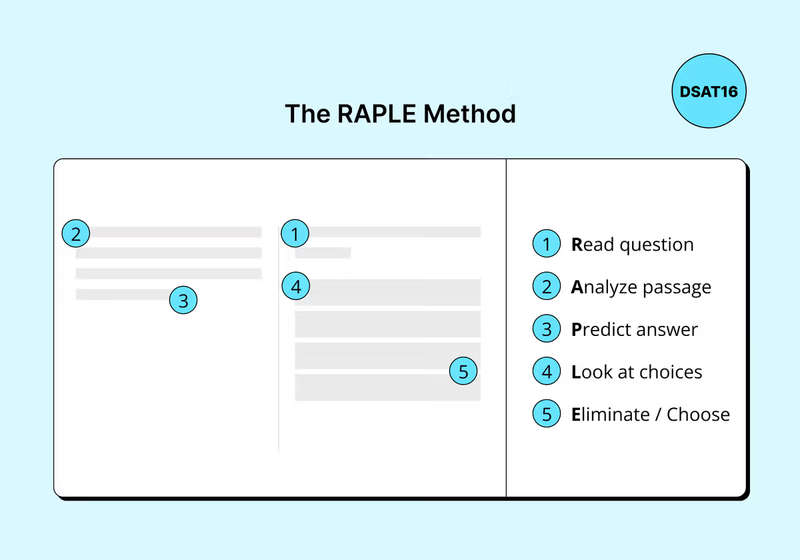
This strategy can genuinely save you 30-60 seconds of second-guessing yourself.
#2: How to Make an Inference
In mathematics, an inference would look something like this:
Example:
a=b & b=c ⇒ a=c
The inference is intuitive, and the symbols are easy to follow.
In the digital SAT, however, things will not be that comfortable for you.
Let’s look at a passage taken from Bluebook:
Example:
Black beans (Phaseolus vulgaris) are a nutritionally dense food, but they are difficult to digest in part because of their high levels of soluble fiber and compounds like raffinose. They also contain anti-nutrients like tannins and trypsin inhibitors, which interfere with the body’s ability to extract nutrients from foods. In a research article, Marisela Granito and Glenda Álvarez from Simón Bolívar University in Venezuela claim that introducing fermentation of black beans using lactic acid bacteria improves the digestibility of the beans and makes them more nutritious.
Unlike the structured language of mathematics, here, the passage is dreadfully long, and the key information is spread across sentences.
Our goal, hence, is to compress these passages down to math-like expressions:
Goal:
Hard to Digest: soluble fiber & raffinose
Antinutrients: tannins & trypsins
Claim: Fermentation → ↑digestibility & nutritious
⇒ Fermentation →↓ tannins, trypsins, soluble fiber, raffinose
Changing
⇒ future: gap decrease
But, how do I actually do this?
Let’s start with a simpler example:
Example:
Recent surveys suggest that although most people still prefer paper over e-book – especially when reading intensively – attitudes are changing.
First, let's try to summarize the main points of this passage, using as few characters as possible.
The key is to rely on contextual clues in the passage. Here’s one way to achieve this:
Compress:
Paper > e-book (!intensive)
Changing
Next, let’s try to deduce more information out of this.
The passage states that “most people still prefer paper over e-book”.
Hence, one information we can conclude from the text is that e-book is a less popular choice compared to paper (e-book < paper).
Moreover, since “attitudes are changing”, we can infer that paper used to be way more popular than e-book, or in the future, the gap between the two will decrease.
Inference:
Paper > e-book (!intensive)
⇒ e-book < paper
These are quite intuitive. As straightforward as they might seem, the actual test will only require you to make simple inferences.
However, be careful of unconsciously making speculations. Wrong answers often refer to information that appears in the passage and could be true, but there isn’t enough information to know that they are absolutely true.
For example, in this case, we cannot conclude that people will prefer e-book over paper in the future, as there isn’t enough information in the passage to know if it is true or not.
Inference:
Paper > e-book (!intensive)
Changing
⇒ future: e-book > paper (this is wrong)
Let’s look at another example:
Example:
Studies have shown that employees are happier, healthier and more productive when they work in an environment that affords them adequate amounts of natural light. New buildings may be designed with these studies in mind, but many older buildings were not, resulting in spaces that often depend primarily on artificial lighting.
Again, let’s extract the key points from this text. If you have trouble understanding it, brush up on your reading comprehension skill.
The passage states that natural light has a positive impact on employees.
One information we can reason out immediately is that employees who are not provided with enough natural light are less happy, healthy, and productive and those who do.
Moreover, since older buildings were not designed with this study in mind, we can also infer that employees working in older buildings are not provided with sufficient natural light.
Here’s the shorter version, written by an employee working in an older building.
Compress:
Natural light = Good
New Building = Natural Light
Old Building = Artificial Light = Less Natural Light
To summarize, we can conclude that employees working in older buildings are less happy, less healthy, and less productive than those who work in new buildings.
Inference:
Natural light = Good
New Building = Natural Light
Old Building = Artificial Light = Less Natural Light
⇒ New Building > Old Building
Let’s try a test-style passage next.
Example:
Cave art represents a remarkable form of human expression that dates back tens of thousands of years. Prehistoric cave artists often used animal fat mixed with minerals to create the pigments for their artwork. Interestingly, animal fat not only helped bind the pigments but also acted as a preservative, allowing some cave art to survive for thousands of years. However, historians have not found any other case where fat is used as a preservative, suggesting that these early creators were not aware of this attribute.
Again, let’s extract the meat and bones from this passage. Here’s a summary written by a caveman.
Compress:
Cave art has fat
Fat = Bind pigments + Preservation
Caveman don’t know fat = preservation
Despite being twice as long as the previous ones, this one is actually quite straightforward.
From this information, we can infer that the fat probably wasn't used for its preservative attribute, or that fat was only used to bind pigments.
Inference:
Cave art has fat
Fat = Bind pigments + Preservation
Caveman don’t know fat = preservation
⇒ Fat used only to bind pigments
#3: Use scratch paper
When I was prepping for the SAT, I constantly faced this one problem.
I always have to go back and forth between the answer choices and the passage.
No matter how hard I used 100% of my brain and try to keep the passage in mind, I always seemed to forget everything when I read the answer choices.
Well, turns out, our brain is not built for that.
Our working memory can only hold about 3-4 pieces of information at once.
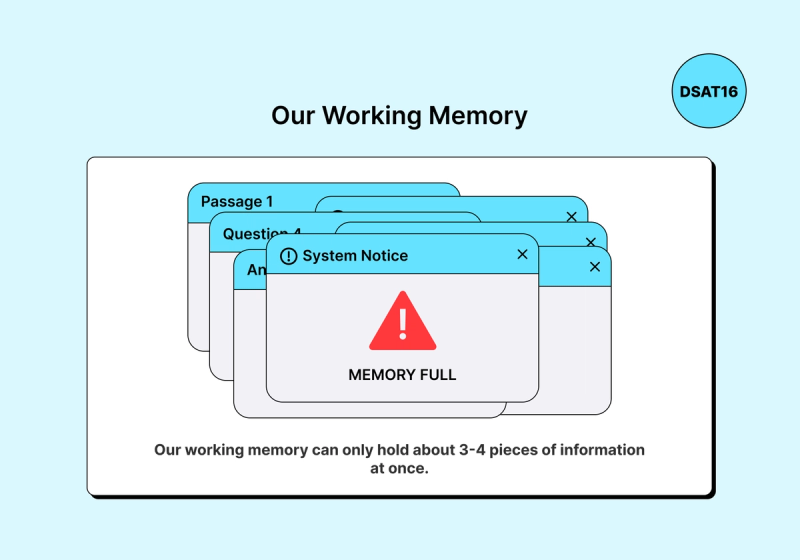
That’s barely enough for the passage. Let alone the answer choices and all the brainstorm we have to do to make sense of them.
That’s why I (and a lot of you) had to reread the passage every 5 seconds.
I don’t need to tell you why reading the passage more than once is suboptimal. The most optimal strategy will only require you to read it once.
Writing everything down on a piece of paper helps with this.
When you write down your compressed version of the passage, you free up your working memory.
You can focus on analyzing the answer choices without constantly rereading the passage. Instead, you now only have to reread the condensed version you have already written.
This makes the process linear. No more rereading.
Practice with SAT Inference Questions Examples
SAT Inference Example 1
Predictive policing is a data-driven law enforcement strategy that aims to anticipate and prevent crimes through advanced analytics and algorithms. For instance, in LA hotspot maps, the implementation of predictive policing was associated with a significant 19% decline in the crime rate. However, other regions that did not adopt predictive policing strategies also observed a similar decline in crime rates during the same timeframe, suggesting that _________
Which choice most logically completes the text?
Select an answer to enable Submit
Let’s follow the principle and summarize the key information.
With predictive policing: 19% decrease
Without predictive policing: ~19% decrease
From this, we can determine that predictive policing has nothing to do with the decline itself, which is what (D) says.
To use process of elimination:
- (A) is wrong because there is no mentioning of local factors in the passage,
- (B) directly contradicts the information before it,
- and (C) is incorrect because we have established that predictive policing has nothing to do with crime rate. Furthermore, the wording is too extreme and subjective to be correct.
Pay attention to extreme words like “all”, “none”, “always”, “never”, “only”,... Answer choices that contain these words are usually incorrect (in some rare instances, they might be correct though so you still need to be careful).
SAT Inference Example 2
In 1966, psychologists asked 84 undergraduates who had never met before to rate each other on five personality traits, based entirely on appearance. For three traits – extroversion, conscientiousness and openness – the observers’ rapid judgements matched real personality scores significantly more often than chance. However, when British psychologists Anthony Little and David Perrett re-ran the experiment using mugshots rather than live subjects, they only found a link between facial appearance and personality for extroversion and conscientiousness. This supports the idea that _________
Which choice most logically completes the text?
Select an answer to enable Submit
Again, let’s approach this question methodically:
Compress:
1st exp (live subjects): appearance → extroversion, conscientiousness, openness
2nd exp (mugshots): appearance → extroversion, conscientiousness
From here we can infer that the answer must talk about the difference between these experiments.
Inference:
1st exp (live subjects): appearance → extroversion, conscientiousness, openness
2nd exp (mugshots): appearance → extroversion, conscientiousness
⇒ difference: openness
This leads us directly to (B), which states that the connection between appearance and personality differs from one method to another.
To use process of elimination:
- (A) can be eliminated directly because there is no information that supports this claim. The text is too objective for it to be correct.
- The same goes for (D). In fact, the passage actually suggests that there is a link between appearance and personality traits, specifically extroversion and conscientiousness.
- Be careful with (C). While the choice initially seems correct, there’s not enough information to determine if it’s 100% true or not.
Conclusion
Hopefully, with this guide, you can know ace Inference questions without overloading your brain.
This blog is part of a SAT Guide series. If you liked this one, you probably don't want to miss the next few.
You can join my email list, and I’ll make sure you will be the first one to know when a post goes live.
Join my email list to get notified when I put out blogs like these!