In this guide, I will show you how to tackle the Central Ideas and Details questions in the digital SAT.
These questions test your reading comprehension skills.
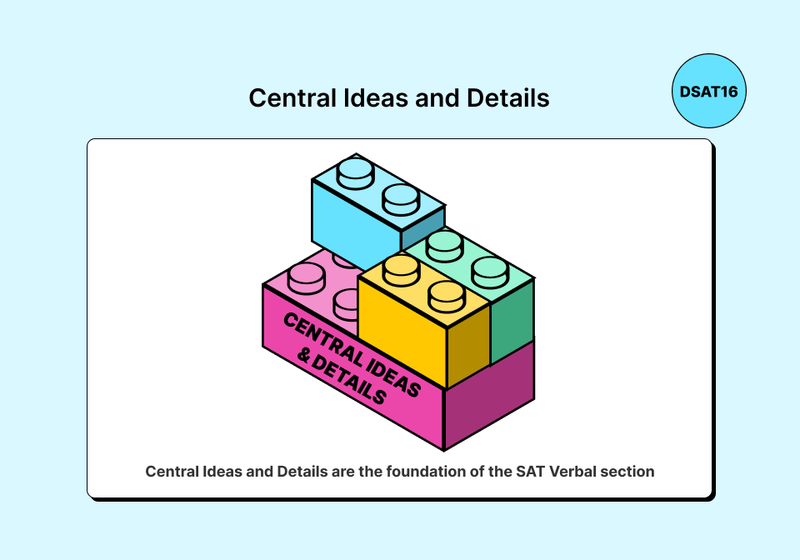
As such, they are the foundation of the SAT Verbal section: if you can’t identify what a passage is really about, you’ll struggle with every other question type.

But here’s the good news: mastering these questions is straightforward.
In this guide, I’ll walk you through:
- the prerequisite skills you need,
- how to quickly identify what a passage is actually about,
- and specific strategies for main ideas and specific details.
By the end, you’ll have a clear framework for approaching every central ideas and details question on the digital SAT.
Let’s start with the foundation.
What are Central Ideas and Details Questions?
In the Reading & Writing section, some questions will give you a passage and ask you a question that tests your understanding of the passage. The length of the text ranges from 75-125 words.
There will be 3-6 Central Ideas and Detail questions per module.
To answer these questions, you won’t need to know any outside knowledge: all the information you need will be in the passage.
Furthermore you won’t need to do any critical reasoning. That’s for Inferences and Command of Evidence.
Unsurprisingly, we can split Central Ideas and Details questions into 2 subtypes:
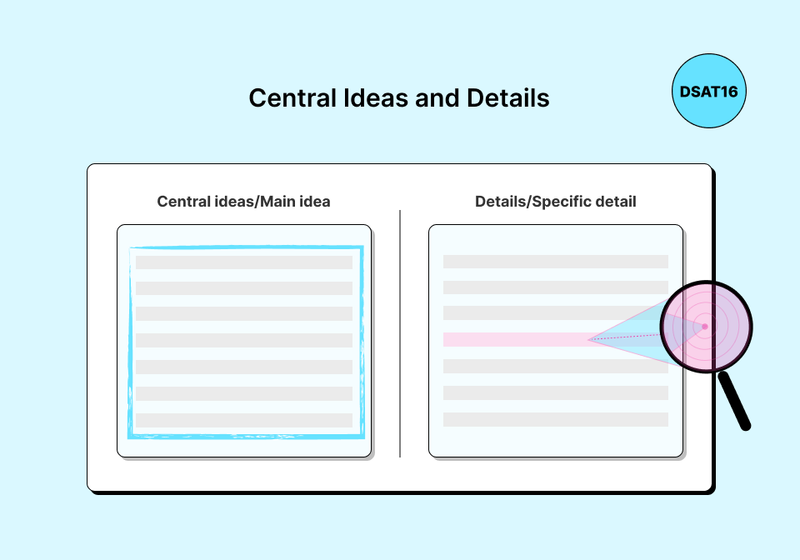
- Central ideas (also known as Main Idea)
- Details (or Specific Detail)
Central Ideas
Central ideas questions will ask you to find the main idea of the passage.
Specifically, the question will always be “Which choice best states the main idea of the text?”
A main idea question look something like this:
Central Ideas Example #1
In a 2010 study, Emily Pronin and Nicholas Epley explored the “Bias Blind Spot,” the tendency to recognize bias in others but not in oneself. Participants read descriptions of psychological biases and estimated the extent to which those biases influenced their own judgments and the judgments of the average person. The results showed that people consistently rated themselves as less susceptible to biases than others, regardless of the specific bias described. This suggests a widespread metacognitive failure in accurately assessing one’s own cognitive shortcomings.
Which choice best states the main idea of the text?
Select an answer to enable Submit
Details
To answer a Details question, you will need to find and use a specific detail mentioned in the passage. Usually, this means that 1-2 key sentences will contain all the information you need to answer the question.
A specific detail question look something like this:
Details Example #1
The following text is from Emily Dickinson’s poem Yesterday is History,. The poem reflects on the elusive and transformative nature of the past as it slips away from the present.
Yesterday is History,
'Tis so far away –
Yesterday is Poetry –
'Tis Philosophy –
Yesterday is mystery –
Where it is Today
While we shrewdly speculate
Flutter both away
What does the text suggest about the relationship between human speculation and the passage of time?
Select an answer to enable Submit
Recommended Prerequisite
Before you can master central ideas and details questions, it’s good to have strong lexical inference skills.
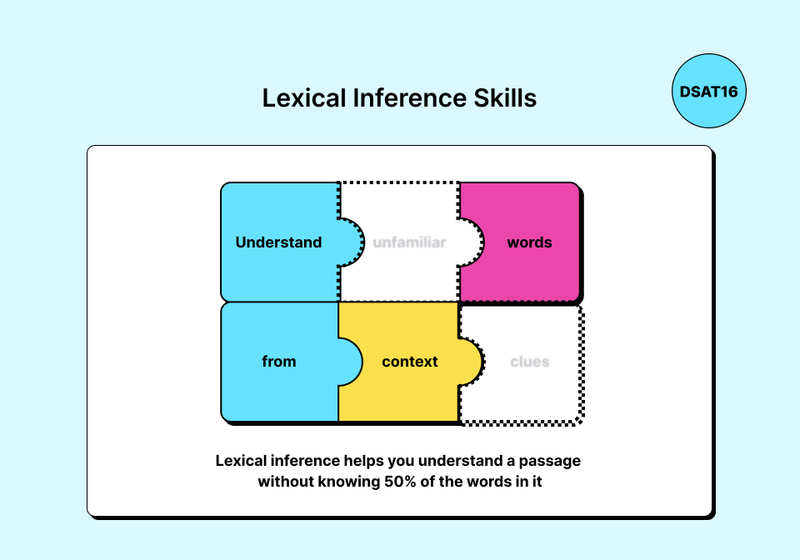
Lexical inference is the ability to understand unfamiliar words from context clues.
Why does this matter?
Because it helps you understand a passage without knowing 50% of the words in it.
The SAT loves to use fancy vocabulary. If you freeze up every time you see an unfamiliar word, you’ll waste your sweet precious time.
But if you can infer meaning from context, you’ll breeze through passages even when they contain challenging vocab.
If you struggle with lexical inference, practice it separately before diving deep into central ideas and details questions. It will make everything else easier.
One simple way to improve this skill is to get better at Words in Context, another question type in the SAT.
Alternatively, you can learn the most common SAT vocab.
Now, let’s move on to the core Reading Comprehension techniques.
#1: How to Find the Topic
The first skill you need to know is how to find the topic of a passage.
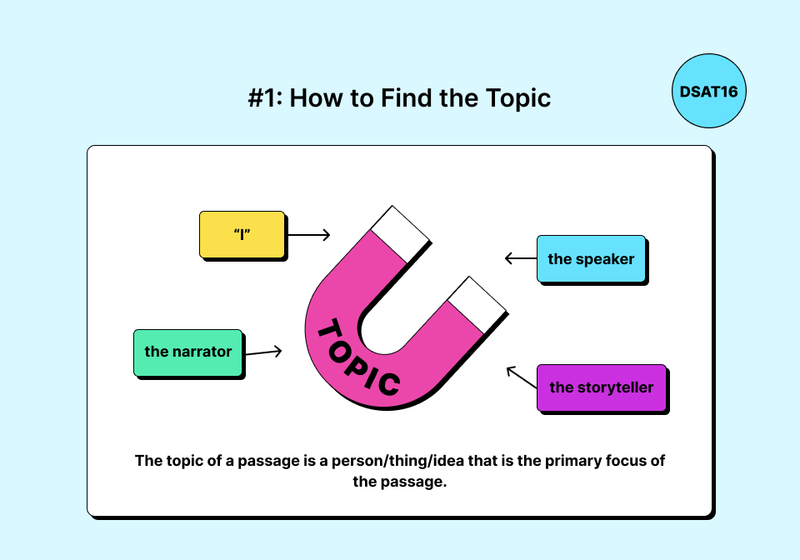
The topic of a passage is a person/thing/idea that is the primary focus of the passage. It often appears repeatedly across the passage, word-by-word or paraphrased.
Why is this important?
Finding the topic of a passage is crucial for understanding the passage. This is because the correct answer choices will refer to the topic.
Furthermore, some answer choices are wrong because they are off-topic, and obviously you can’t know whether it is off-topic or not if you don’t know the topic.
In fact, sometimes, knowing the topic alone can make you arrive at the answer immediately, even on harder questions in module 2.
Here are 2 ways to find the topic of a passage.
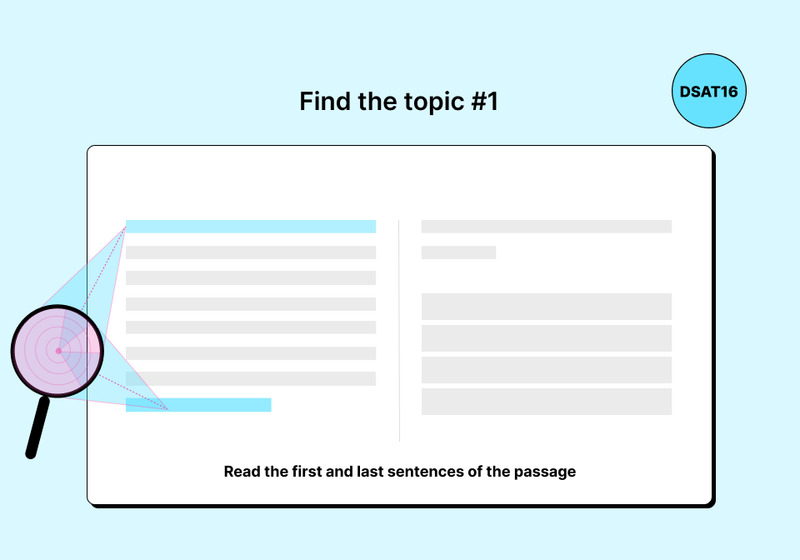
Read the first and last sentences of the passage
The first and last sentences of paragraphs often contain key information that summarizes the topic of that passage.
By scanning these sentences carefully, you can get a quick glimpse of the topic discussed there.
Let’s take a look at this passage:
In his 1959 book, The Presentation of Self in Everyday Life, sociologist Erving Goffman introduced the dramaturgical approach. This perspective uses the metaphor of theater to understand social interaction. Goffman argued that individuals are like actors on a stage, presenting a “performance” to others. This performance is shaped by the environment and the audience, with individuals managing their impressions to align with desired goals.
Immediately from the 1st sentence, we already know that the topic will be about “the dramaturgical approach”.
If you don’t know what that means, no need to worry. Just keep it in mind and pay attention to it through out the passage.
Pay attention to repeated words or phrases
If you notice certain words or phrases being repeated throughout the passage, it's likely that they represent the topic of the passage.
Most of the time, though, the topic will not be repeated word-for-word. Instead, the passage will paraphrase or use synonyms to refer to the same concept.
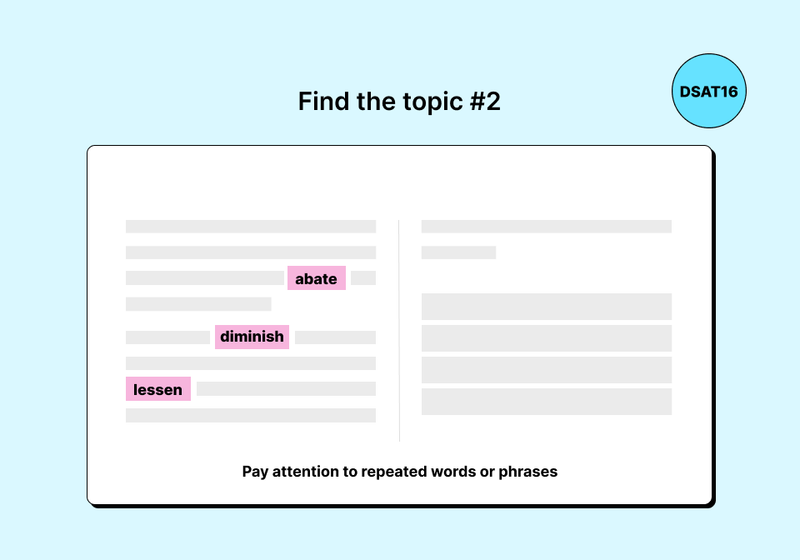
In the earlier example, “the dramaturgical approach” was then referred to as “this perspective“. Afterwards, it is explained further in terms of “a performance”.
#2: How to Trace Ideas Across Passage
Oftentimes, a passage won’t only have just 1 idea.
Instead, the author will constantly shift the focus from an idea to another within the passage.
This is where tracing ideas becomes essential.
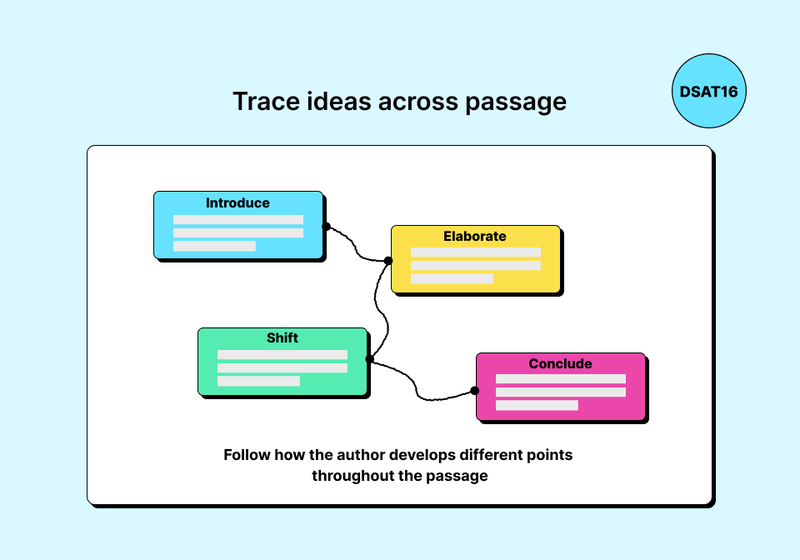
Tracing ideas means following how the author develops different points throughout the passage.
If you know how to do this properly, you’ll understand the structure of the passage.
You’ll see which sentences introduce new concepts, which ones elaborate on previous points, and which ones shift direction entirely.
So, how do you do this?
Look for transitions
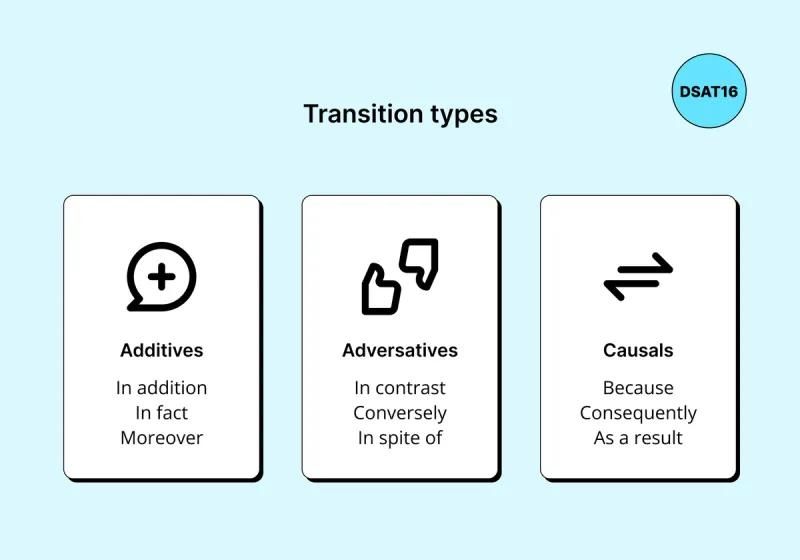
If you have already prep for Transitions questions, you should already know that there are 3 types of transitions:
- Additives provide additional context.
- Adversatives are used to provide contrast.
- Causals signal a cause-and-effect relationship.
So, what’s so important about them?
Transitions act as signposts that guide you through the author’s thought process.
Let’s take a look at the passage below:
During the Harlem Renaissance, many artists sought to reclaim and celebrate African heritage in their work. The painter Aaron Douglas, for instance, incorporated motifs from West African sculpture into his murals and illustrations. Similarly, the poet Langston Hughes, in his collection The Weary Blues, drew on the rhythms and structures of blues and jazz music, which have deep roots in African musical traditions.
In this example, the transitions “for instance“ and “similarly“ tell you how the ideas connect.
If you are speed reading and only glancing through the passage, the transitions will still help you guess that the 2nd sentence will provide an example for the 1st sentence, and the 3rd sentence will be similar to the 2nd sentence.
By recognizing these transitions, you can quickly map out how ideas connect and flow throughout the passage.
This makes it much easier to predict the direction of the passage and understand how each sentence relates to the others.
Pay attention to punctuations
Certain punctuation marks can also signal important information.
For example, colon, dashes, and parentheses are often used to introduce additional information for the subject of the passage.
Let’s take a look at this passage:
In a 1968 study, social psychologists John Darley and Bibb Latané investigated how the presence of others affects an individual’s response to an emergency. Participants believed they were discussing personal problems with other students via an intercom system. During the discussion, one “student” (actually a pre-recorded actor) simulated having a seizure. Researchers found that participants who believed they were the only other person listening were much quicker to seek help than those who believed other students were also present.
Notice the parentheses in the passage above: “one ‘student’ (actually a pre-recorded actor).”
They provide clarifying information. While the information itself is not significant, it helps a lot with contextualizing the passage.
Now that we know how to find the topic and trace ideas across a passage, we’re ready to tackle the questions head-on.
Let’s get straight into it.
Central Ideas
Central Ideas questions will ask you to identify the main idea of a given text.
The main idea of a passage is the primary argument that the author wants to convey. It is the topic and the reason the author wants to introduce that topic.
Like the topic, the main idea will often be introduced in the first or second sentence and will come up in the last sentence for emphasis.
#3: The 5-step framework
Here’s my 5-step process for answering Central Ideas questions:
- Read the question
- Read the passage
- Identify the topic
- Identify the main idea
- Read the answer choice and pick the one that matches.
Looks pretty standard, right?
However, there are a few small tricks we can do to optimize this process further.
Firstly, we know that the first and last sentences are important.
Thus, you should try to keep the pace and only slow down at the first and last sentence, or any information that you deem useful.
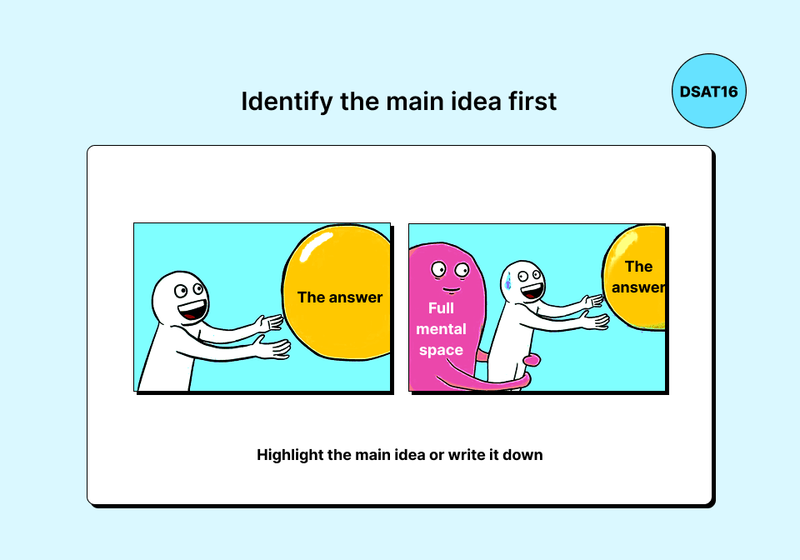
Secondly, you should either highlight the main idea if it is already in the passage or write it down if it isn’t.
This makes evaluating answer choices less taxing on your brain.
It frees up mental space so you can focus on answering the question rather than trying to remember what you thought the main idea was.
Let’s see this framework in action:
Central Ideas Example #2
In her 2017 book, Lincoln in the Bardo, George Saunders challenges traditional historical narratives by blending factual accounts with imaginative scenarios. The novel explores the grief experienced by Abraham Lincoln following his son’s death, but also depicts the spirits in a bardo, a Tibetan Buddhist concept of a transitional state after death. Saunders uses historical details as a backdrop to delve into themes of love, loss, and empathy. Through this approach, Saunders suggests that historical understanding can be deepened through creative interpretation.
Which choice best states the main idea of the text?
Select an answer to enable Submit
Next, let’s look into 3 different types of passages, going from easiest to hardest.
#4: Science Passage
Identifying the main idea of a science passage is usually straightforward.
This is because science passages are typically written to communicate a specific scientific concept or idea.
Hence, the author will often state the main idea in the first or second sentence of the passage right away.
Central Ideas Example #3
In a 2010 study, ecologist Jing Chen investigated the impact of climate change on the Qilian juniper (Juniperus przewalskii) in China. Chen found that warmer temperatures led to earlier vegetation green-up in the spring, but also increased the risk of frost damage due to unexpected cold snaps. This resulted in reduced growth and, in some cases, mortality of the Qilian juniper. Chen’s work suggests that the Qilian juniper is becoming more vulnerable, highlighting the complex effects of climate change on high-altitude ecosystems.
Which choice best states the main idea of the text?
Select an answer to enable Submit
#5: Fiction Passage
Identifying the main idea of a fiction passage can be troublesome because it will not be explicitly stated like those for science passages.
However, a fiction passage will most likely still focus on an aspect (i.e. characteristic, scenery, trait) of a person or place.
The place where you can find the main idea will also be very similar to that of science passages (a.k.a. The first and last sentence).
Central Ideas Example #4
The following text is adapted from Frances Hodgson Burnett’s 1911 novel The Secret Garden. In this passage, the character Dickon is describing a mother bird and her hardworking mate to Mary Lennox.
“She has been workin’ hard all day,” said Dickon. “She’s been workin’ hard all day feedin’ them nestlings, and now she’s glad to rest. It’s hard work, raisin’ a family. And he’s been helpin’ her—the little chap. When he’s got them gapin’ beaks filled, she feels like she was a lady with nothin’ to do. She says she’s seen the little chaps when it seemed like the sweat must be droppin’ off 'em, though folk can’t see it.”
Which choice best states the main idea of the text?
Select an answer to enable Submit
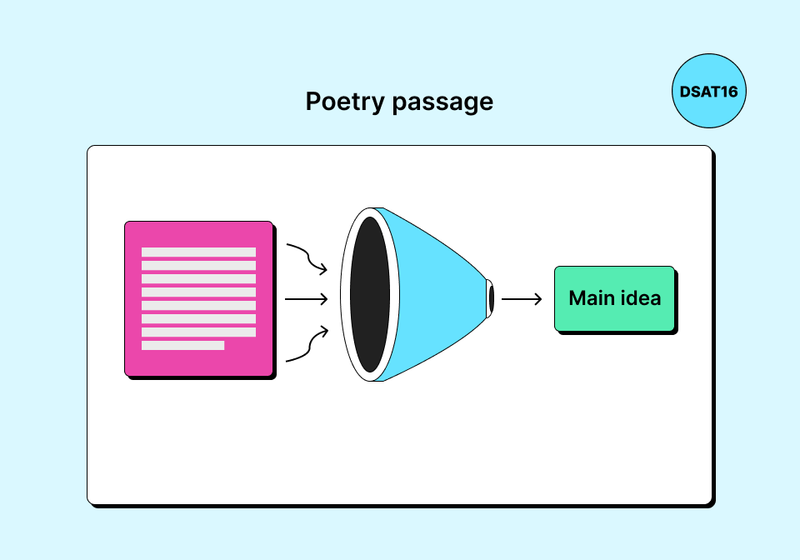
#6: Poetry Passage
Now this one is hard.
Identifying the main idea of a poetry passage can be extra troublesome due to the challenging, old English syntax and vocab.
For this, you will need to broaden your logic and connect certain metaphors in the passage with bigger ideas.
However, you must also stay within the boundaries of the passage and not make any assumptions that are not supported by the specific wording.
The one advice I will give here is to not be hung up on words you do not understand.
Instead, try to extract the most information out of the words that you can understand.
Central Ideas Example #5
The following text is from Emily Dickinson’s poem Which is best? Heaven –. In this poem, the speaker contemplates the certainty of earthly experiences versus the uncertainty of the afterlife.
Which is best? Heaven –
Or only Heaven to come
With that old Codicil of Doubt?
I cannot help esteem
The “Bird within the Hand”
Superior to the one
The “Bush” may yield me
Or may not
Too late to choose again.
Which choice best states the main idea of the text?
Select an answer to enable Submit
Next, let’s move on to Details.
Details
Details questions zoom in a little bit and ask you about a specific detail mentioned in the passage.
While it may not seem like it, you do not need to make any inferences nor outside knowledge. The answer will always be in the passage.
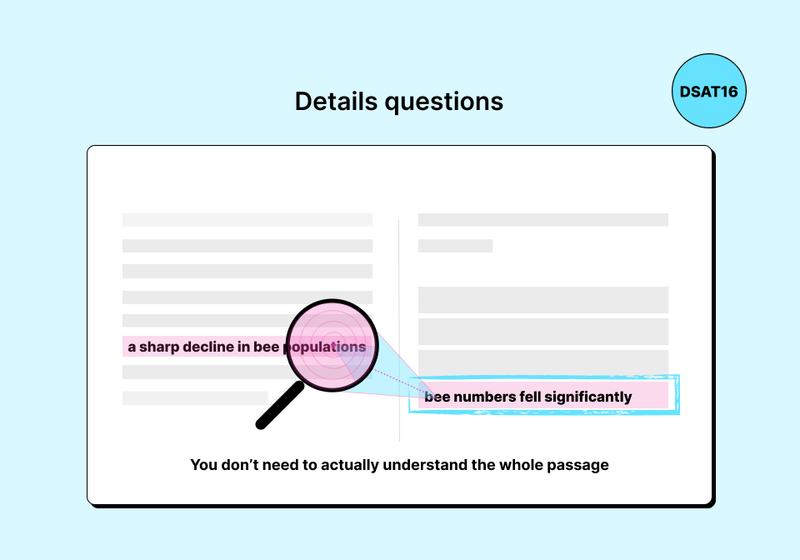
However, it will not be stated word-for-word. That would be too easy.
Instead, the correct answer will be phrased in a different and often more general way.
This is both a good and a bad thing.
Why?
You don’t need to actually understand the whole passage. You actually only need to understand it enough to be able to recognize a paraphrased version of it.
Let’s take a deeper dive.
#7: Finding the Paraphrased Version
A paraphrased version is when the same information is expressed using different words.
Specifically, the correct answer will restate a detail from the passage several using paraphrasing techniques:
- Synonyms: Swapping words for ones with similar meanings (e.g., “investigated” becomes “studied”)
- Different sentence structures: Rearranging how the information is presented
- More general language: Summarizing specific details into broader terms
For example, if the passage says “The researcher observed a 47% increase in plant growth,” the correct answer might say “The scientist noticed significant improvement in how the plants developed.”
Same idea. Different framing.
When you read the answer choices, ask yourself: “Does this say the same thing as the passage, just in a different way?”
If it does, you’ve found your paraphrased match.
Let’s practice with a few examples:
Details Example #2
Noticing a consistent rise in IQ scores from one generation to the next, New Zealand political scientist James Flynn did much to document it and promote awareness of its implications. However, the term "Flynn effect" was not coined by him to describe this intriguing phenomenon. Through extensive research, he found that the effect is universal: it has been observed in diverse populations and across different cultures. Subsequently, researchers have proposed several potential factors contributing to the Flynn effect, including improved nutrition and healthcare and environmental changes.
According to the text, what is true about the Flynn effect?
Select an answer to enable Submit
Let’s try another question, this time with harder vocab:
Details Example #3
The following text is from Emily Brontë’s 1847 novel Wuthering Heights. In this passage, the narrator, Heathcliff, compares his own son, Linton, to Hareton Earnshaw, the son of his late enemy Hindley.
But there’s this difference; one is gold put to the use of paving-stones, and the other is tin polished to ape a service of silver. MINE has nothing valuable about it; yet I shall have the merit of making it go as far as such poor stuff can go. HIS had first-rate qualities, and they are lost: rendered worse than unavailing. I have nothing to regret; he would have more than any but I are aware of. And the best of it is, Hareton is damnably fond of me! You’ll own that I’ve outmatched Hindley there.
According to the text, what distinction does Heathcliff draw between his son and Hareton?
Select an answer to enable Submit
Conclusion
Thanks to this blog, now you are ready to tackle Central Ideas and Details questions.
While some of them look intimidating, ultimately, they only test your surface level reading comprehension.
Now that you have mastered that skill, you should not have any problems with these 2 question types now.
Reading comprehension skills are also crucial for Text Structure and Purpose, another SAT Verbal question type.
So make sure that you practice them regularly.