Since the 2022 AI boom, artificial intelligence has been widely adopted in every aspect of society, one of them being education.
In fact, AI usage in education among students has skyrocketed since then. However, the year-on-year adoption rate is slowing down.
So, how big is AI in education, and how has it affected classrooms?
Overview (Top 10 Fun Facts)
- 95% of UK undergraduates report using AI in at least one way, and 94% use generative AI to help with assessed work.
- 54% of US K-12 students used AI for schoolwork in 2025, up more than 15 percentage points in one to two years.
- 64% of US teens (ages 13–17) use AI chatbots, and 54% use them specifically for schoolwork help.
- 60% of US K-12 teachers used AI for work in 2024–25, but only 18% report receiving any formal guidance on how to use it.
- 65% of UK students say their assessments have changed significantly because of AI, up from 56% in 2025.
- 51% of US students worry they could be falsely accused of cheating with AI, even if they didn't use it.
- 45% of US principals report having a school or district AI policy.
- 15% of UK students now use AI for friendship, company, advice, or to address loneliness.
- 68% of UK students believe AI skills are essential to thrive in today's world, but only 48% feel staff are helping them build those skills.
- 38% of UK institutions now provide students with AI tools, up from just 9% in 2024.
Sources: HEPI/Kortext; RAND Corporation; Pew Research Center; Gallup
Market Statistics
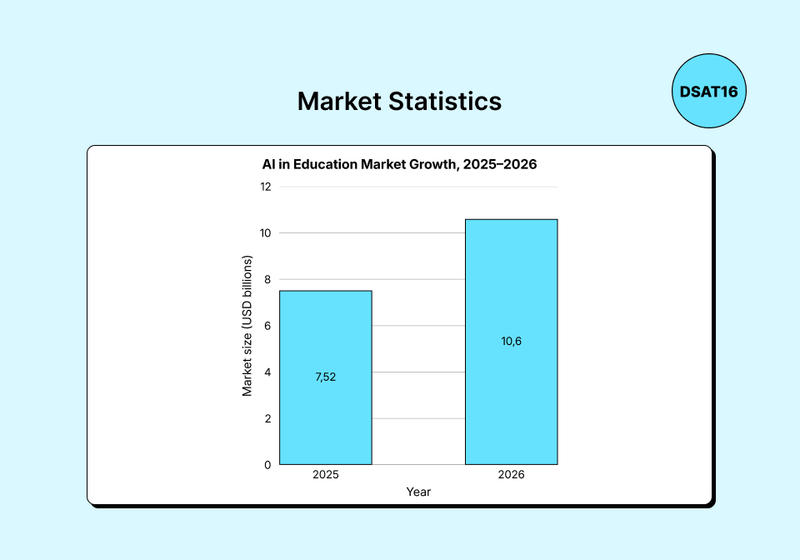
- The AI in education market size grew from $7.52 billion in 2025 to $10.6 billion in 2026, representing a compound annual growth rate (CAGR) of 40.9%.

| Year | AI in Education Market Size (USD) |
|---|---|
| 2025 | $7.52 billion |
| 2026 | $10.6 billion |
- The market is projected to reach $42.48 billion by 2030, with a CAGR of 41.5%.
- For context, the global education market as a whole was estimated at $7 trillion in 2025, meaning AI in education currently represents a small but rapidly growing segment.
- Recent major investments signal strong confidence in the sector. For example, Preply raised $150 million to advance human-led, AI-enhanced learning.
Sources: Research and Markets; Ken Research Global Education Market; Preply
Education AI Usage Statistics
Student Statistics
How Many Students Are Using AI?
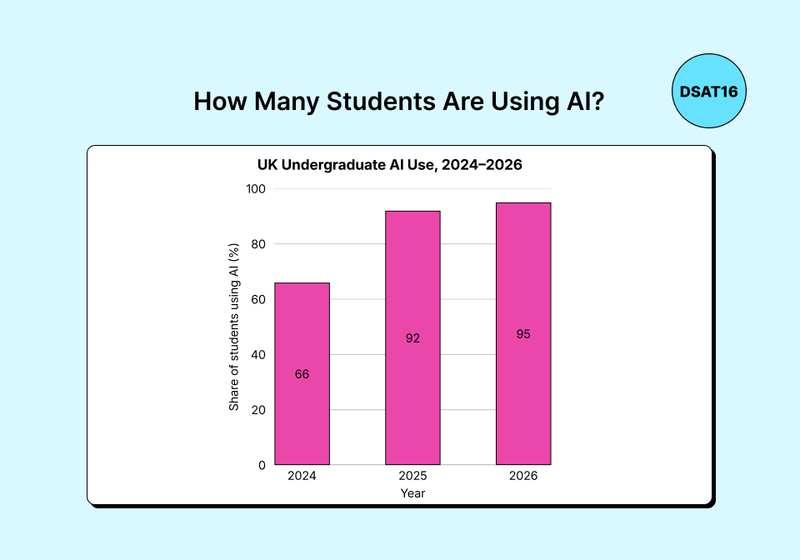
- 95% of UK full-time undergraduates report using AI in at least one way in 2026, up from 92% in 2025 and 66% in 2024.
| Year | UK Undergraduates Using AI |
|---|---|
| 2024 | 66% |
| 2025 | 92% |
| 2026 | 95% |
- 94% of UK students say they use generative AI to help with assessed work, up from 89% in 2025 and just over half two years prior.
- 54% of US middle and high school students said they used AI for schoolwork to some extent in winter 2025, with 41% of middle schoolers and 61% of high schoolers reporting use.
- 21% of US students use AI for schoolwork at least once a week or more.
- 64% of US teens (13–17) say they use AI chatbots at all, while only about half of parents believe their teen does.
- 10% of US teens say they do all or most of their schoolwork with a chatbot's help; another 44% do some or a little.
Sources: HEPI/Kortext; RAND Corporation; Pew Research Center
How Are Students Using AI?
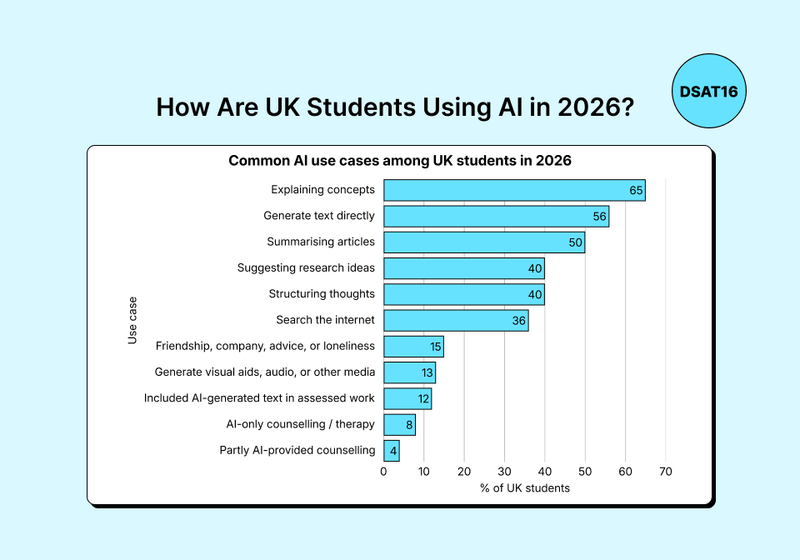
- The most common UK student use cases are explaining concepts (65%), summarising articles (50%), suggesting research ideas, and structuring thoughts (around 40% each).
- 56% of UK students use AI to generate text directly (e.g., via ChatGPT), down from 64% in 2025.
- 12% of UK students say they have included AI-generated text directly in assessed work, up from 8% in 2025 and 3% in 2024.
- 36% of UK students now use AI to search the internet, and 13% use it to generate visual aids, audio, or other media — both new categories for 2026.
| AI Use Case (UK Students, 2026) | % of UK Students |
|---|---|
| Explaining concepts | 65% |
| Generate text directly | 56% |
| Summarising articles | 50% |
| Suggesting research ideas | 40% |
| Structuring thoughts | 40% |
| Search the internet | 36% |
| Friendship, company, advice, or loneliness | 15% |
| Generate visual aids, audio, or other media | 13% |
| Included AI-generated text in assessed work | 12% |
| AI-only counselling / therapy | 8% |
| Partly AI-provided counselling | 4% |
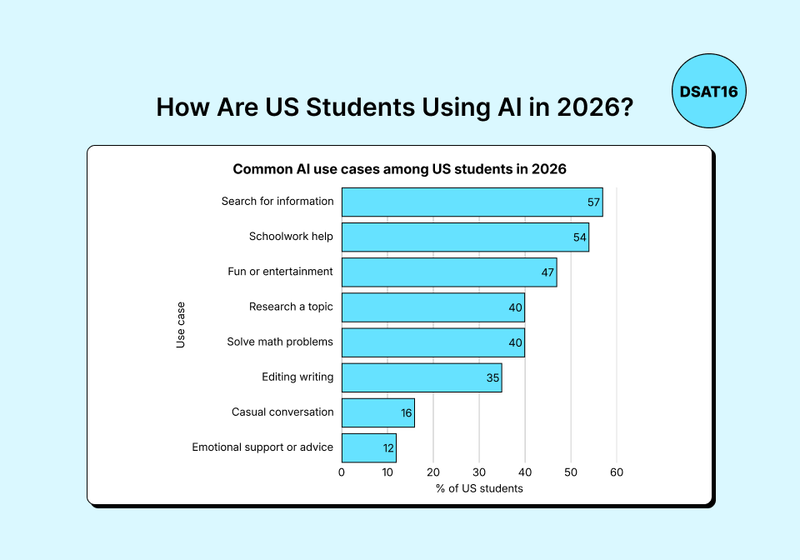
- Among US teens, 57% have used chatbots to search for information and 54% for schoolwork help, while 47% use them for fun or entertainment.
- About four-in-ten US teens have used chatbots to research a topic or solve math problems; 35% have used them for editing writing.
- 15% of UK students use AI for friendship, company, advice, or to address loneliness; 8% use AI-only counselling or therapy services and 4% use partly AI-provided counselling.
- 16% of US teens have used chatbots for casual conversation, and 12% for emotional support or advice.
| AI Use Case (US Students, 2026) | % of US Students |
|---|---|
| Search for information | 57% |
| Schoolwork help | 54% |
| Fun or entertainment | 47% |
| Research a topic | 40% |
| Solve math problems | 40% |
| Editing writing | 35% |
| Casual conversation | 16% |
| Emotional support or advice | 12% |
Popular AI Tools Among Students
- ChatGPT remains the most widely used AI tool among UK students at 56% usage, followed by tools like Kortext for summarising/note-taking (31%) and Grammarly for editing (24%).
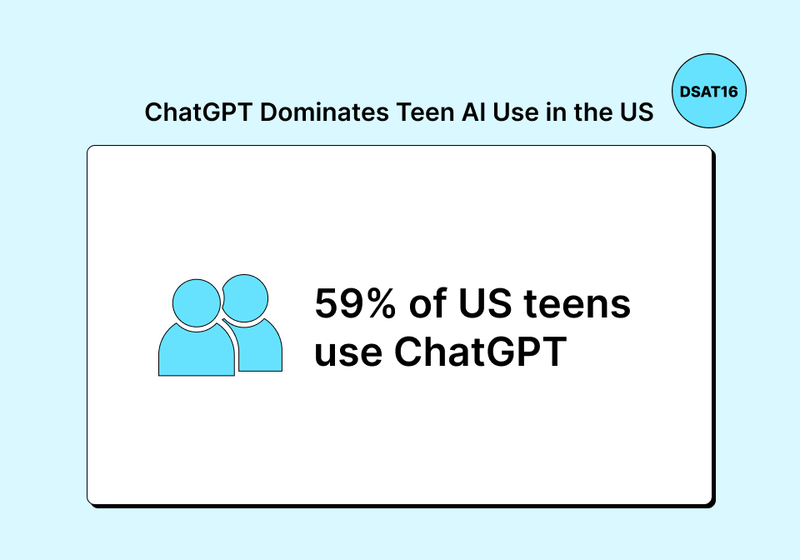
- ChatGPT dominates among US teens too, used by 59% of chatbot users, followed by Google Gemini at 23%.
Sources: HEPI/Kortext; AceQuiz
Educator/Teacher Statistics
How Many Teachers Are Using AI?
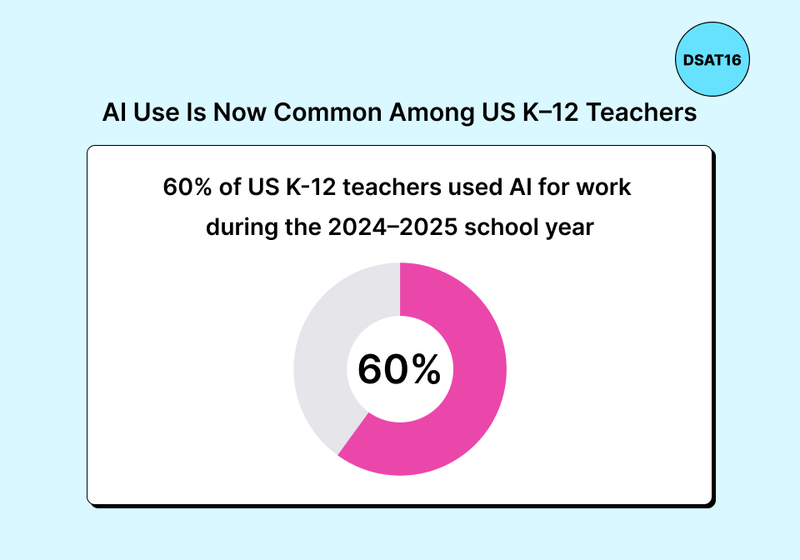
- 60% of US K-12 teachers used AI for work during the 2024–25 school year, including 30% who used it at least weekly.
- 53% of US K-12 ELA, math, and science teachers reported using AI for instructional planning or teaching in spring 2025, up from 25% in 2024.
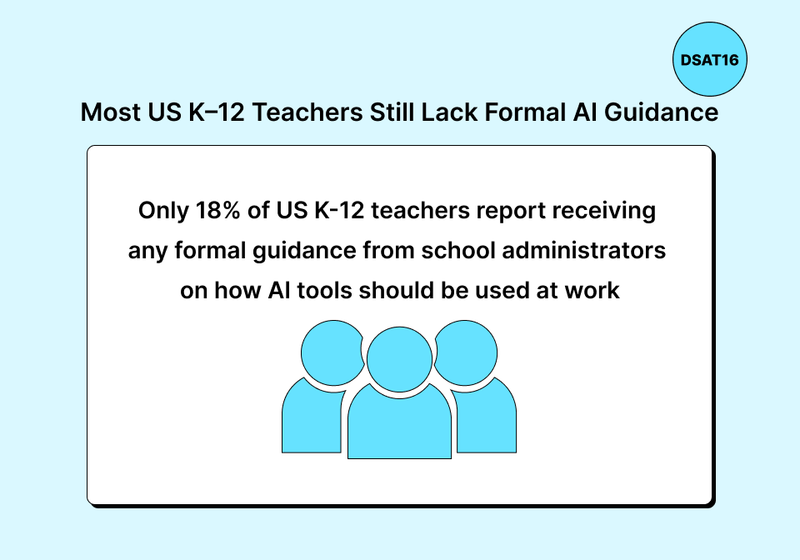
- Despite this widespread use, only 18% of US K-12 teachers report receiving any formal guidance from school administrators on how AI tools should be used at work.
- 34% of teachers receive no guidance at all on AI use across the 10 work tasks Gallup measured, while 48% receive only informal guidance (verbal conversations or shared norms rather than written policy).
- Guidance gaps are starkest for tasks involving direct student interaction: 69% of teachers say they get no guidance on using AI for one-on-one instruction or tutoring, and 58% say the same for grading and providing feedback.
Source: Gallup
How are they using AI
- AI use among teachers rises with grade level: 42% of elementary teachers, 64% of middle school teachers, and 69% of high school teachers report using it.
- District leaders' own estimate of student AI use (46%) falls between middle schoolers' (42%) and high schoolers' (61%) self-reported figures, suggesting leaders have a reasonably accurate read on usage in their districts.
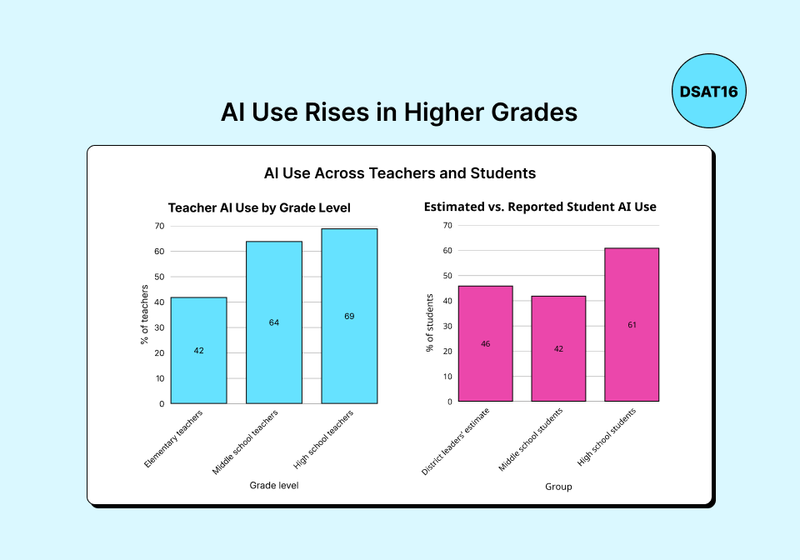
| Teacher Grade Level | % of Teachers Using AI |
|---|---|
| Elementary school teachers | 42% |
| Middle school teachers | 64% |
| High school teachers | 69% |
| Group | % of Students Using AI |
|---|---|
| District leaders' estimate | 46% |
| Middle school students (reported) | 42% |
| High school students (reported) | 61% |
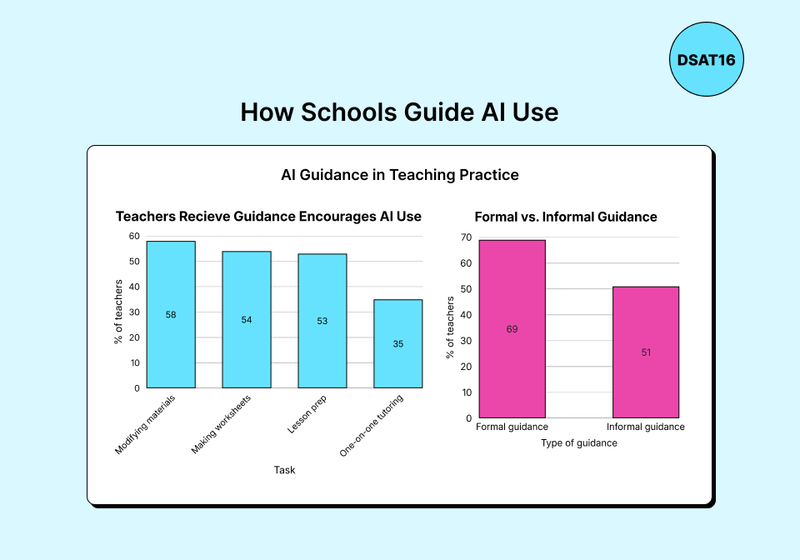
- Where teachers do receive guidance, it most often encourages AI use for instructional preparation, such as modifying student materials (58%), making worksheets or assignments (54%), and lesson prep (53%).
- However, the guidance is far more ambiguous for one-on-one tutoring (35% encouraged).
- Discouragement is rare overall, but grading is the task where it's most common: 10% of teachers who receive guidance on AI-assisted grading say they're discouraged from using it, the highest rate of any task measured.
- Teachers who receive formal guidance are more likely to feel encouraged to use AI than those who only get informal guidance — for example, 69% vs. 51% for making student materials.
| Task | % of Teachers Whose Guidance Encourages AI Use |
|---|---|
| Modifying materials | 58% |
| Making worksheets | 54% |
| Lesson prep | 53% |
| One-on-one tutoring | 35% |
| Type of Guidance | % of Teachers Encouraged to Use AI |
|---|---|
| Formal guidance | 69% |
| Informal guidance | 51% |
Sources: RAND Corporation; Gallup
Impact of AI in Education
- 65% of UK students say their institution's assessments have changed significantly because of AI, up from 56% in 2025 and just 32% in 2024.
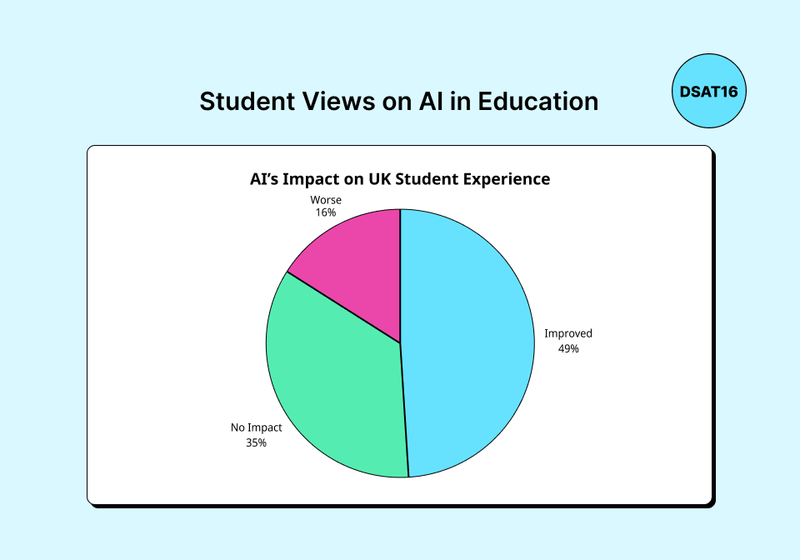
- 49% of UK students feel AI has improved their overall student experience (somewhat or significantly); 16% feel it has made things worse, and 35% report no significant impact.
| AI's Impact on UK Student Experience | % of UK Students |
|---|---|
| Improved | 49% |
| No impact | 35% |
| Worse | 16% |
- 41% of UK students say AI affects their level of loneliness. The figure splits almost evenly between 21% feeling less lonely and 20% feeling more lonely; 59% report no impact.
- 61% of US parents and 48–55% of US students (middle and high schoolers, respectively) agree that greater AI use will harm critical-thinking skills, compared with only 22% of school district leaders.
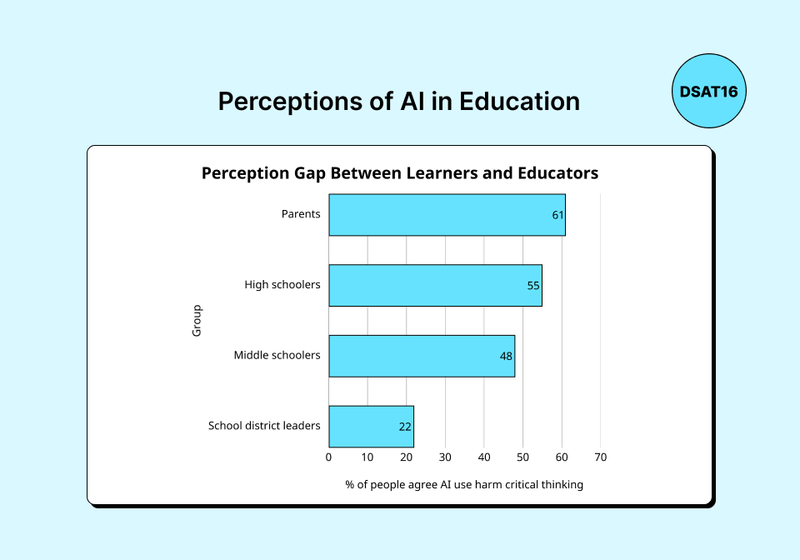
| Group | % Who Agree AI Use Harms Critical Thinking |
|---|---|
| Parents | 61% |
| High schoolers | 55% |
| Middle schoolers | 48% |
| School district leaders | 22% |
- 68% of UK students believe AI skills are essential to thrive in today's world, but only 48% feel their teaching staff are helping them develop those skills for their careers.
Pros & Cons of Generative AI in Education
Pros
- UK students who feel AI improved their experience most often cite time savings, help structuring ideas, and round-the-clock instant support for understanding concepts.
- 45% of UK students say saving time is a reason they're more likely to use AI tools, and 40% cite improved work quality.
- A small share of students describe AI as a source of company or support when they feel lonely, comparing it to "having a study buddy."
- More UK students believe institutions are embracing AI: only 21% now say institutional bans/discouragement reduce their AI use, down from 31% in 2025.
Source: HEPI/Kortext
Cons
- The top reasons UK students say they're less likely to use AI are fear of being accused of cheating (42%), getting false results/hallucinations (35%), and getting biased results (32%).
- 23% of UK students now cite environmental impact as a reason to avoid AI tools, up from a smaller share in 2025.
- 51% of US students say they worry about being falsely accused of cheating with AI even when they haven't used it; 16% say this has actually happened to them or someone they know.
- Some UK students report that AI use has worsened their experience by increasing assessment difficulty, reducing critical thinking, or contributing to social isolation.
- 59% of US teens believe AI cheating happens at least somewhat often at their school, including about a third who say it happens extremely or very often.
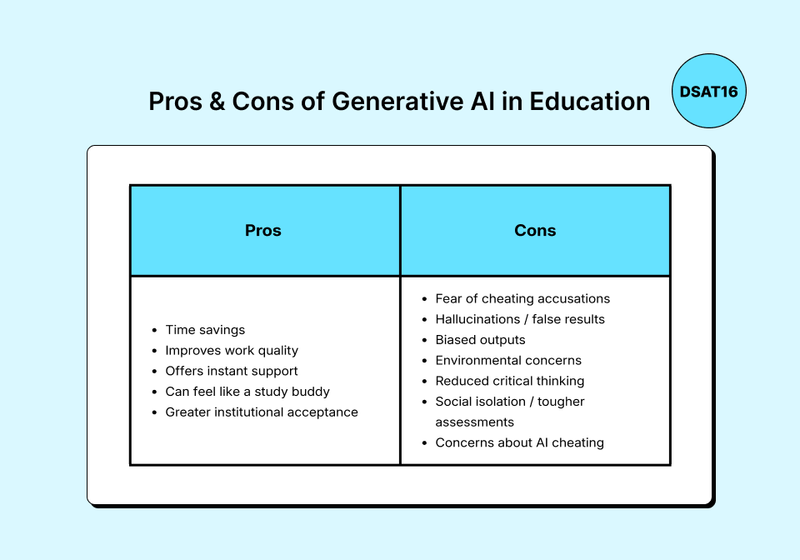
| Pros | Cons |
|---|---|
| Time savings | Fear of cheating accusations |
| Improves work quality | Hallucinations / false results |
| Offers instant support | Biased outputs |
| Can feel like a study buddy | Environmental concerns |
| Greater institutional acceptance | Reduced critical thinking |
| Social isolation / tougher assessments | |
| Concerns about AI cheating |
Sources: HEPI/Kortext; RAND Corporation; Pew Research Center
AI Use Cases in Education
- Explaining concepts is the most common assessment-related use case among UK students (65%), followed by summarising articles (50%) and structuring thoughts (40%).
- 36% of UK students use AI to search the internet for their studies, and 13% use it to generate visual aids, audio, or other media.
- US teens most commonly use chatbots for general information search (57%) and schoolwork help (54%), followed by entertainment (47%) and summarising content (around four-in-ten).
- A minority of students use AI for non-academic, wellbeing-related purposes: 15% of UK students for friendship/loneliness support, and 12% of US teens for emotional support or advice.
- Institutionally, the most commonly provided AI tools cited by UK students are ChatGPT and Microsoft Copilot, alongside tools like Grammarly and Turnitin.
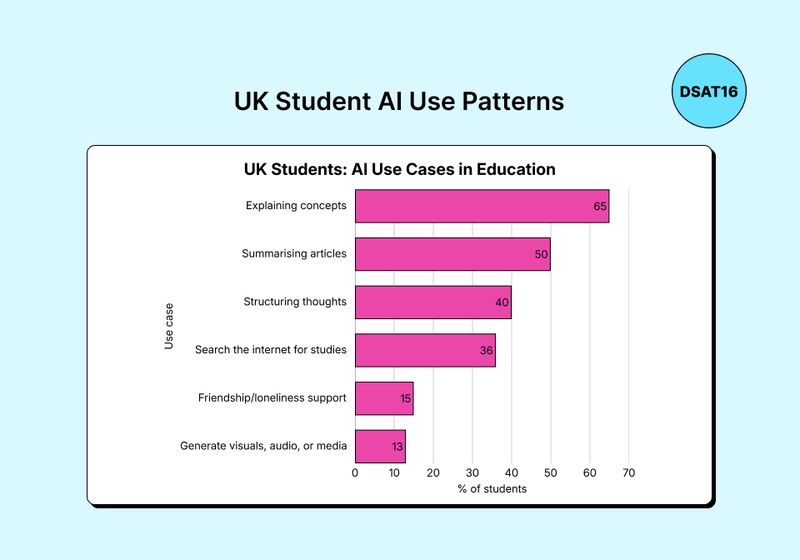
| AI Use Case (UK Students) | % of UK Students |
|---|---|
| Explaining concepts | 65% |
| Summarising articles | 50% |
| Structuring thoughts | 40% |
| Search the internet for studies | 36% |
| Friendship/loneliness support | 15% |
| Generate visuals, audio, or media | 13% |
Sources: HEPI/Kortext; Pew Research Center
AI and Cheating
The Most Common AI Cheating Methods
- Generating text and including it directly in assessed work without disclosure is the most cited concern, with 12% of UK students admitting to doing this in 2026 (up from 8% in 2025).
- 24% of US students believe using AI for schoolwork is "always" cheating, while the vast majority of parents (77%) say it depends on the context, and only 7% of parents say it's never cheating.
- 26% of US students say teachers at their school definitely use detection tools to check for AI use; 40% are unsure whether such tools are used.
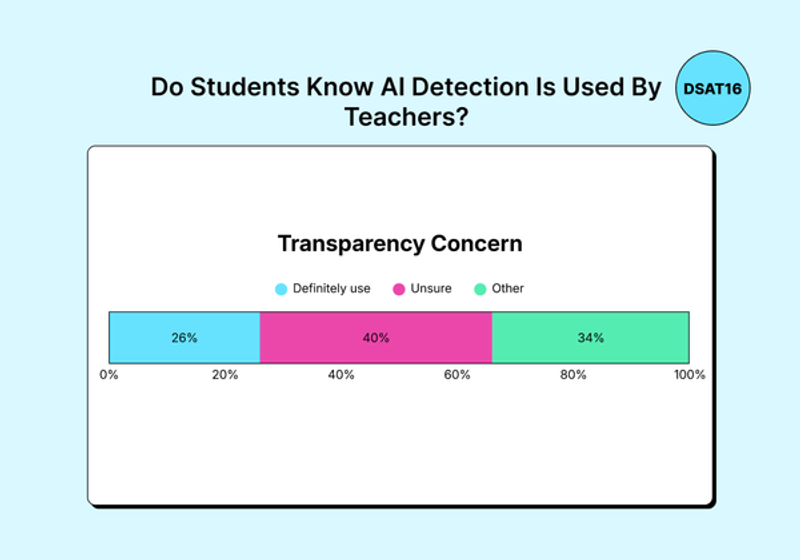
| Do Teachers Use AI Detection? (Student Responses) | % of US Students |
|---|---|
| Definitely use | 26% |
| Unsure | 40% |
| Other | 34% |
Sources: HEPI/Kortext; RAND Corporation
Most Common Cheating Methods Experienced by High Schoolers
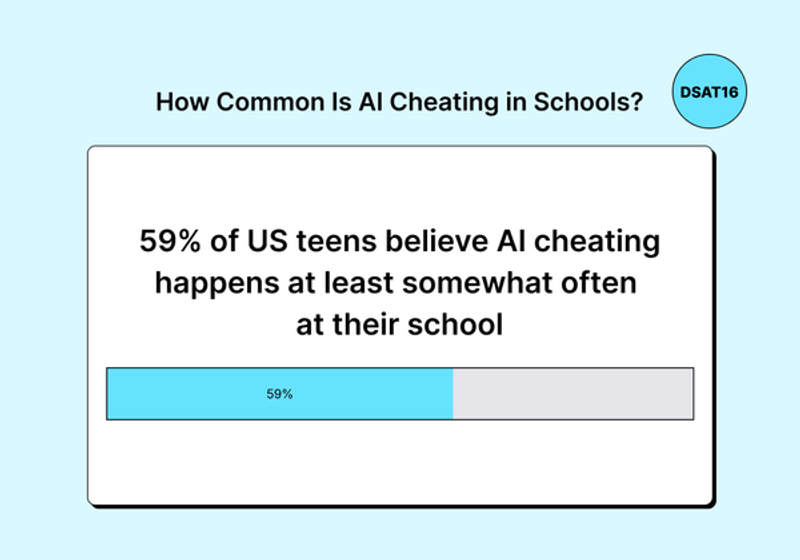
- 59% of US teens believe AI cheating happens at least somewhat often at their school; this rises to 76% among teens who have personally used chatbots for schoolwork help.
- 53% of US high school students say they worry about being falsely accused of cheating with AI, compared with 44% of middle schoolers.
- 30% of US high schoolers say teachers definitely use AI-detection tools, compared with 16% of middle schoolers.
- Only 34% of US teachers report that their school or district has put academic-integrity policies specifically related to generative AI in place, and adoption is roughly twice as common in high schools (49%) as in elementary schools (22%).
Sources: RAND Corporation; Pew Research Center
Attitudes Towards AI in Education
Attitudes Towards AI in Educational Aspects
- 37% of UK students agree their institution encourages AI use, compared with 36% who disagree, a near-even split.
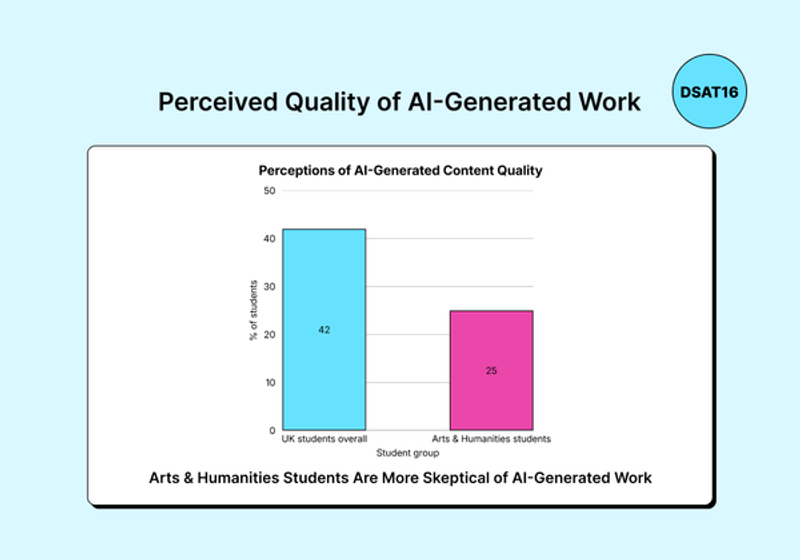
- 42% of UK students believe AI-generated content would get a good grade in their subject; Arts and Humanities students are far more skeptical (25%) than other subjects.
| Student Group | % Who Think AI-Generated Work Would Get a Good Grade |
|---|---|
| UK students overall | 42% |
| Arts & Humanities students | 25% |
- 36% of teens think AI's impact on them personally over the next 20 years will be positive, versus 15% who think it will be negative; teens are more split on AI's impact on society (31% positive vs. 26% negative).
- About half of US teens think AI would do a worse job than humans at making hiring decisions, while teaching a skill is the only task where more teens think AI would outperform humans (about a third).
- 56% of US teens say they've heard "a lot" about AI chatbots, and another 39% have heard "a little"; about a quarter report high confidence using these tools.
Sources: HEPI/Kortext; Pew Research Center
Attitudes Towards AI in Emotional Aspects
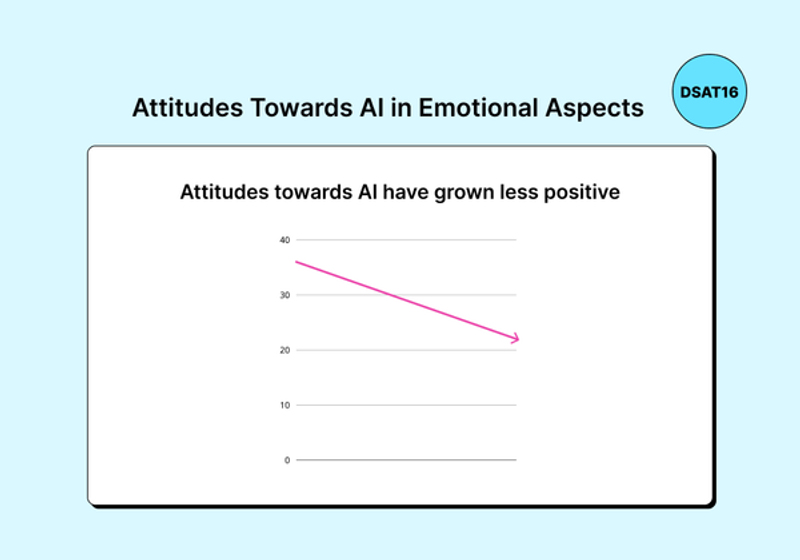
- In 2026, excitement about AI among Gen Z has dropped 14 percentage points to 22%, and hopefulness has fallen 9 points to 18%, while anger about the technology has risen 9 points to 31%; anxiety remains steady at 42%.
| Year | Gen Z Excitement About AI |
|---|---|
| 2025 | 36% |
| 2026 | 22% |
- Curiosity is currently Gen Z's most common emotional response to AI, felt by 49%, more than any other emotion measured.
- Emotional response to AI tracks closely with usage: 69% of daily AI users report feeling curious and 44% feel excited, compared with just 28% curious and 4% excited among those who never use AI.
- Negative emotion is concentrated among non-users — 60% report anxiety and 59% report anger about AI, versus 28% and 18% respectively among daily users.
- Even daily users have grown less positive: their excitement is down 18 points and hopefulness down 11 points from a year earlier, even as their anxiety and anger levels held steady.
- 80% of Gen Z say it is "very" (34%) or "somewhat" (46%) likely that using AI tools will make it harder for them to learn in the future.
- Gen Z's confidence that AI speeds up learning has fallen 7 points to 46%, and confidence that it speeds up work has fallen 10 points to 56%, compared with 2025.
- More Gen Z think AI will hurt rather than help their ability to think carefully about information (42% harmful vs. 25% helpful) or come up with new ideas (38% harmful vs. 31% helpful).
Equity and Inclusivity Concerns
- UK students from higher social grades (A, B, C1) report higher usage of several AI tools than those from lower social grades (C2, D, E) — for example, 59% vs. 51% for text generation and 20% vs. 13% for coding tools — despite free versions of tools like ChatGPT being widely available.
- Male UK students have historically been more likely than female students to have prior experience using AI before arriving at university, though this gender gap has narrowed slightly year over year.
- Teen boys are more likely than girls to view AI's future impact positively, both for themselves (41% vs. 30%) and for society (35% vs. 27%), and are more confident than girls that AI could outperform humans on tasks like customer service, driving, and teaching a skill.
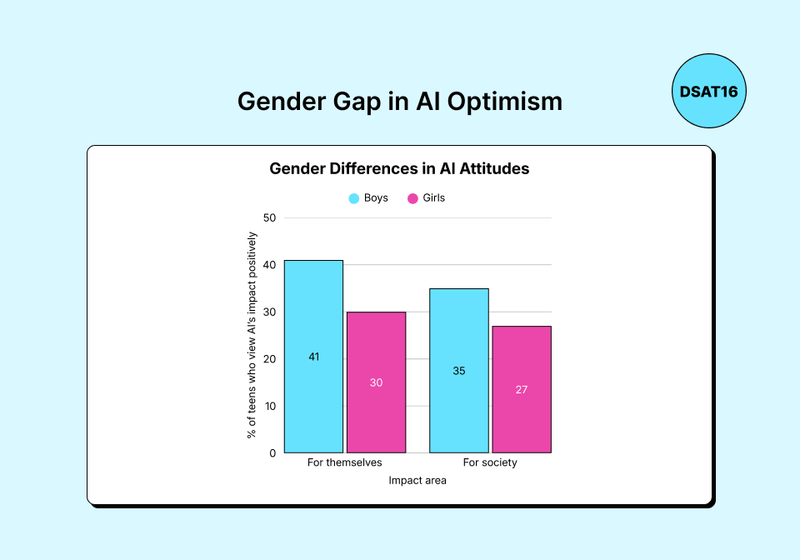
| % of Teens Who View AI's Impact Positively | Boys | Girls |
|---|---|---|
| For themselves | 41% | 30% |
| For society | 35% | 27% |
- Arts and Humanities students are consistently the most skeptical and least supported group in the UK data: only 25% think AI-generated content would get a good grade in their subject (vs. 42% overall), and they are the least likely to feel their lecturers help them develop AI skills for their careers.
- Black and Hispanic US teens are more likely than White teens to use chatbots for schoolwork help (roughly six-in-ten vs. about half), to find chatbots helpful, and to say they do all or most of their schoolwork with a chatbot's help.
- 21% of Black US teens say they've used chatbots for emotional support or advice, compared with about one-in-ten Hispanic or White teens; Black teens are also more likely to use chatbots for casual conversation and for getting news.
- Household income shapes how heavily teens rely on AI for schoolwork: 20% of US teens in households earning under $30,000 a year say they do all or most of their schoolwork with a chatbot's help, compared with just 7% of teens in higher-earning households.
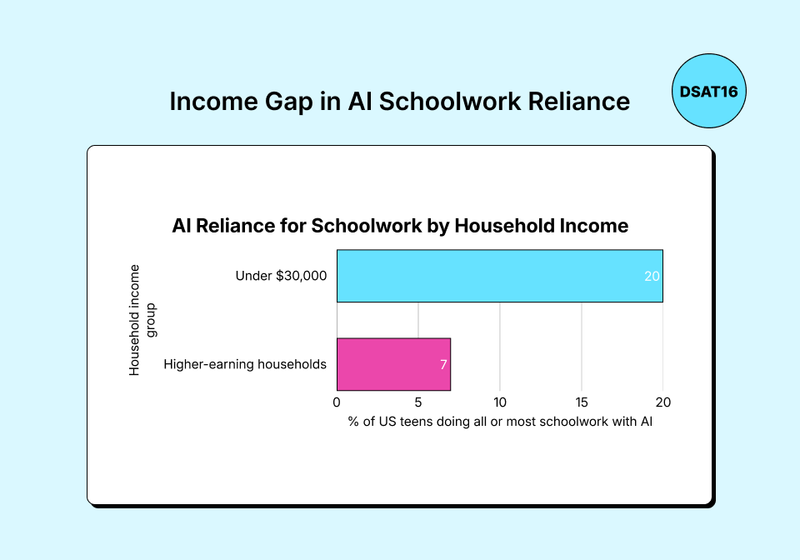
| Household Income | % of US Teens Doing All or Most Schoolwork With AI |
|---|---|
| Under $30,000 | 20% |
| Higher-earning households | 7% |
- Confidence in using chatbots also varies by race: 37% of Black US teens report high confidence, compared with about a quarter of Hispanic (26%) or White (23%) teens.
Sources: HEPI/Kortext; Pew Research Center
Future Trends
- The global AI in education market is projected to keep accelerating, with estimates ranging from $32.27 billion by 2030 to $136.79 billion by 2035.
- UK institutions providing AI tools directly to students jumped from 9% in 2024 to 23% in 2025 to 38% in 2026. Though, this still trails the 50% of students who think their institution should provide such tools.
- The formal-guidance gap shows no sign of closing quickly: as of 2026, just 18% of US K-12 teachers have a written AI policy to work from, leaving most to set their own norms task by task.
- On the student side, school-level policy is moving faster: the share of US K-12 students who say their school has AI rules jumped from 51% in 2025 to 74% in 2026, and access to AI tools from school computers rose from 36% to 49% over the same period.
- Among students whose school has a policy, 65% are now permitted to use AI for schoolwork, up from 55% in 2025 — though only 28% of all students say their school actually provides them with AI tools to use.
- K-12 students' confidence that they'll have the skills needed for daily AI use after graduation rose 12 points year over year, to 56% in 2026.
Sources: HEPI/Kortext Student Generative AI Survey 2026; RAND Corporation, AI Use in Schools Report; Gallup, "Most Teachers Receive No Formal Guidance on AI Use" (2026); Gallup, "Gen Z's AI Adoption Steady, but Skepticism Climbs" (2026); AceQuiz, "50+ AI in Education Statistics for 2026"