In this blog, I will show you how to tackle Rhetorical Synthesis, also known as Student Notes.
When the digital SAT first came out, this was the easiest question type ever. However, College Board has been setting some traps to make them harder.

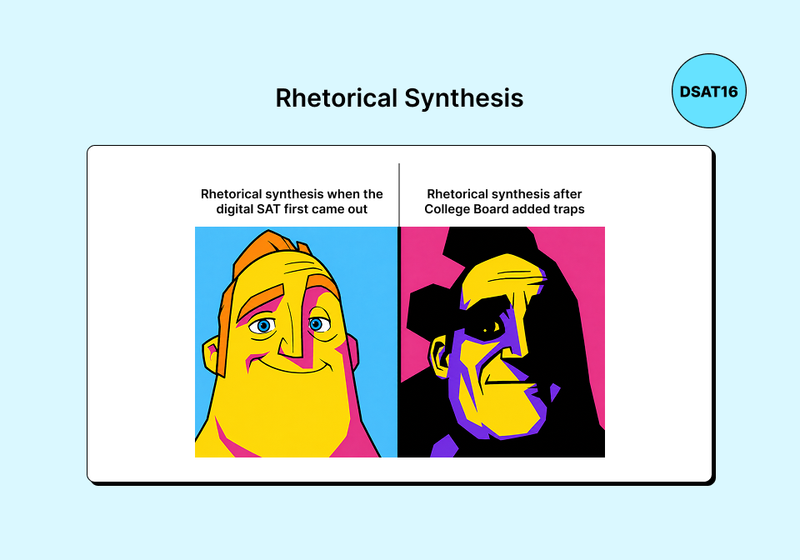
This blog will help you overcome those traps and answer these questions in less than 20 seconds.
Let’s dive right in.
What are Rhetorical Synthesis Questions
In the digital SAT English section, Student Notes questions consist of a list of bullet points at the left of the screen and a question asking you to use information from there to introduce or emphasize a certain claim.
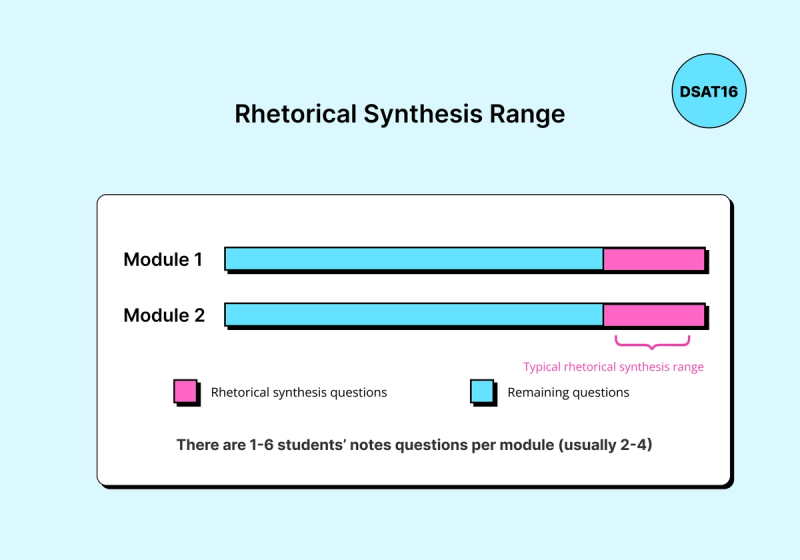
There are 1-6 Students’ Notes questions per module (but usually 2-4). These questions are always located at the end of the module.
Student Notes questions look intimidating: they are usually long and complex. However, as you will soon see, they are pretty straightforward and easy if you know the strategy.
So, what is the strategy exactly?
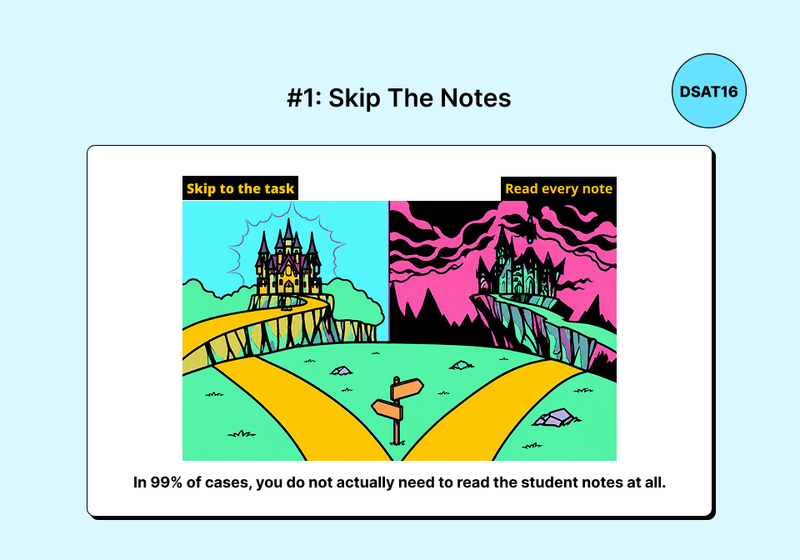
#1: Skip the notes
This is the most influential piece of advice you will ever get for this question type.
In 99% of cases, you do not actually need to read the student notes at all.
Why?
They are only there to provide factual background information, and most of the time, the answer choices will be factually correct.
Let’s try an example. Trust me on this one and skip the left part entirely.
Digital SAT Student Notes Example #1
While researching a topic, a student has taken the following notes.
- The Manhattan Project was a secretive research project conducted by the United States during World War II.
- It was initiated in 1939 with the goal of developing atomic weapons to ensure the defeat of Germany and Japan.
- The project brought together leading scientists, including Albert Einstein and Robert Oppenheimer, who worked on nuclear technology and weaponization.
- The project led to the creation of the first atomic bombs.
- These bombs were subsequently used on the Japanese cities of Hiroshima and Nagasaki in August 1945, effectively ending the war.
The student wants to introduce the primary aim of the project. Which choice most effectively uses relevant information from the notes to achieve this goal?
Select an answer to enable Submit
Only looking at the right side, we can see the key word in the question here is “introduce the primary aim of the project”, which is the Manhattan Project if you look at the answers.
Now let’s look at each answer:
- (A) talks about people in the project and what they are working on.
- (B) explains what the Manhattan Project is and its consequences.
- (D) focuses on the bombs created in the project rather than the project itself.
- Only (C) mention the word “goal“, which is the primary aim of the project.
As you can see, you did not have to use the left side AT ALL. This is a powerful trick that has been used ever since the Digital SAT came out...
Until College Board patched it.
Take a look at this example from Bluebook Practice Test #10:
Digital SAT Student Notes Example #2
While researching a topic, a student has taken the following notes:
- Puntius javanicus is a species of commercially raised fish.
- Researchers in Indonesia recently found that adding pineapple extract to fish food increased both the feed utilization efficiency and the growth rate of P. javanicus.
- Adding the pineapple extract did not affect total food consumption.
- The researchers thus determined that the increased growth rate resulted from the increased feed utilization efficiency.
- The enzyme bromelain in pineapple extract enhances the hydrolysis of ingested proteins.
- This allows the fish to more readily absorb them.
The student wants to explain how pineapple extract increased the growth rate of P javanicus. Which choice most effectively uses relevant information from the notes to accomplish this goal?
Select an answer to enable Submit
Here, if you also skip the left side, you will see that both (B) and (D) can be correct. Checking the left side, you will see that (B) contradicts the 3rd bullet point.
So, what does this mean for you?
Luckily, only the hardest module 2 rhetorical synthesis questions are like this.
Therefore, you should still skip the notes first and try to eliminate answer choices based on the question alone. In most cases, you’ll narrow it down to one or two options.
Afterwards, quickly scan the bullet points to verify which answer is factually correct.
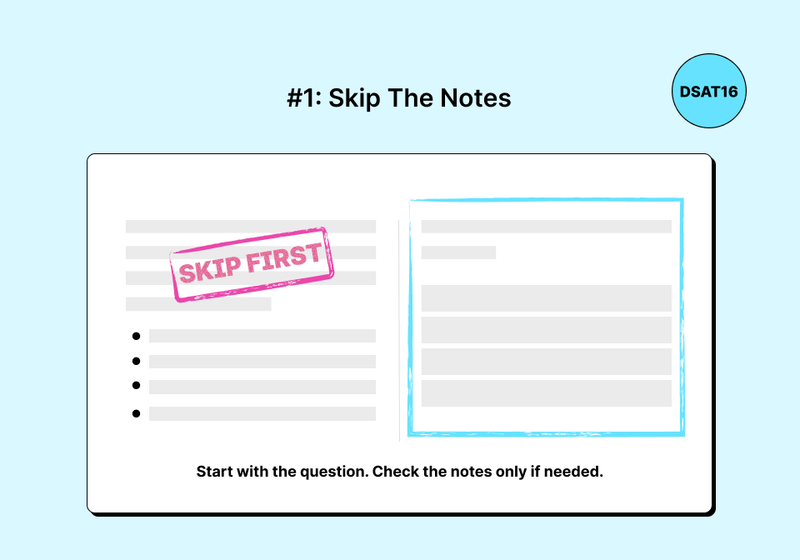
This approach saves you precious time: instead of reading all the notes upfront, you’re only checking them when you need to break a tie between two strong candidates.
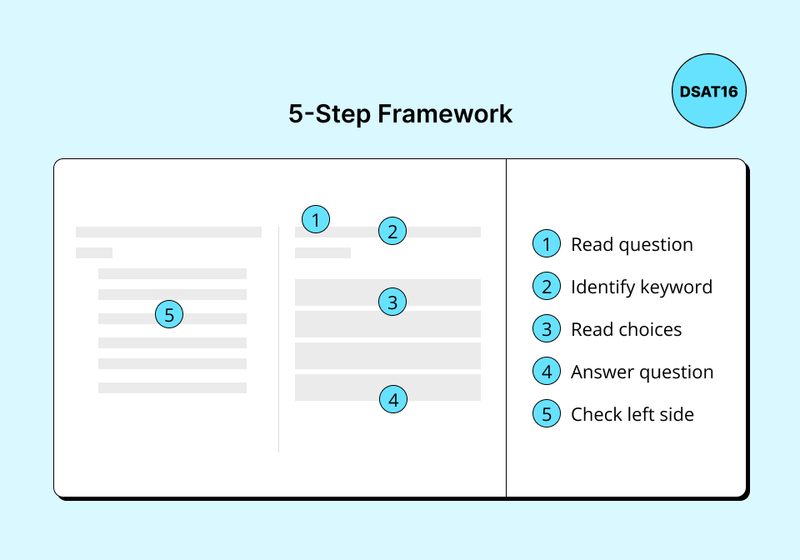
To summarize, this is the step-by-step approach for Student Notes:
- Read the question
- Identify the key phrase in the question
- Look at the answer choices
- Try to answer the question
- If there are still 2 or more valid choices, read the notes and eliminate the factually incorrect one(s).
Now that you’ve learnt the basic approach to Student Notes questions, let’s look at 2 specific variations that appears frequently on the digital SAT.
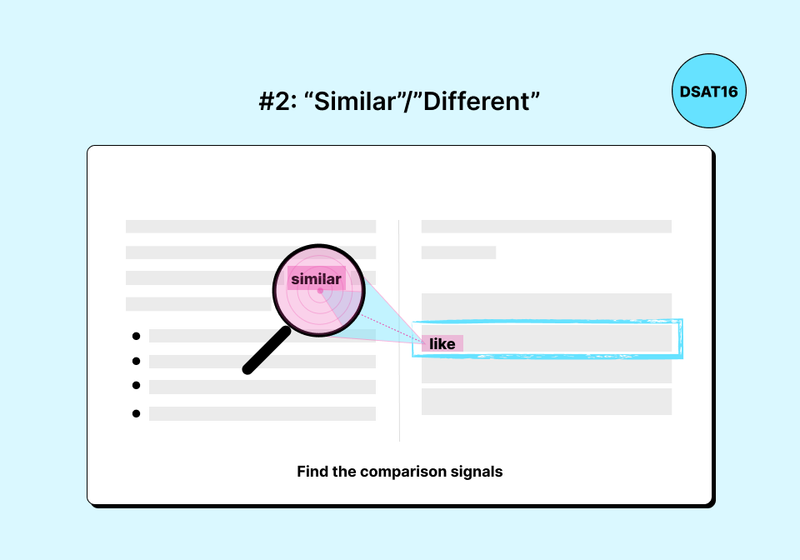
#2: “Similar”/”Different”
This one is pretty straightforward.
If you see words like “similar” or “different” in the question, look for comparative words like “like”, “unlike”, “whereas”,... in the answer.
Let’s take a look at a Student Notes practice question.
Digital SAT Student Notes Example #3
While researching a topic, a student has taken the following notes.
- Philosophy is the study of fundamental questions about existence, knowledge, ethics, logic, and the nature of reality.
- Aristotle was a Greek philosopher who lived from 384 to 322 BCE.
- He focused on studying the natural world empirically, emphasizing observation and analysis to understand the essence and characteristics of objects and concepts.
- Plato was another Greek philosopher who lived from 427 to 347 BCE.
- He believed in the existence of a separate realm of forms or ideas, which he considered to be the ultimate reality.
The student wants to emphasize a difference between the two philosophers. Which choice most effectively uses relevant information from the notes to achieve this goal?
Select an answer to enable Submit
Here we can spot the word “difference” in the question. Hence, we’ll need to look for a comparative word in the correct answer.
Only D is suitable, as it contains the word “while”, connecting two different ideas.
#3: “Unfamiliar”
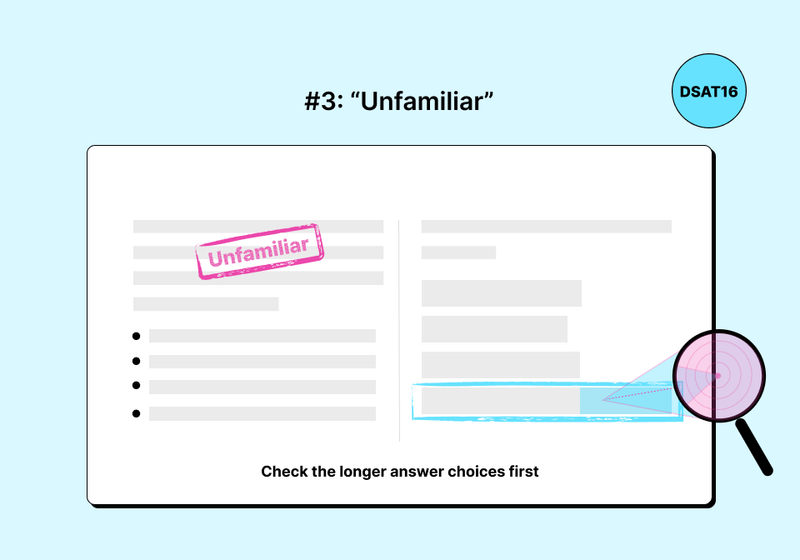
For ”unfamiliar” questions, the correct answer have to include an additional clause providing background or extra information about the subject.
As a result, correct answers to these are often longer. Hence, a strategy for you to save time is to check the longer answer choices first.
Let’s take a look at an example:
Digital SAT Rhetorical Synthesis Example #4
While researching a topic, a student has taken the following notes.
- Edward Hicks was an American folk artist known for his paintings of religious and moral themes.
- His paintings are now on display in museums and galleries around the world.
- His paintings often reflect his beliefs in peace, simplicity, and equality.
- His most famous painting is The Peaceable Kingdom, which depicts a scene of animals living together in harmony.
- The painting is based on a passage from the Book of Isaiah.
The student wants to introduce The Peaceable Kingdom to an audience unfamiliar with the art. Which choice most effectively uses relevant information from the notes to achieve this goal?
Select an answer to enable Submit
Here, the student wants to introduce a piece of art to someone unfamiliar with it. Therefore, the correct answer should have some kind of intro or explanation about the art.
Looking at the answers, we can see that only (A) and (B) have an introduction. However, the introduction in (A) is about the artist, not the art itself. (B) is the correct answer.
Let’s look at another example.
Digital SAT Rhetorical Synthesis Example #5
While researching a topic, a student has taken the following notes.
- Jane Austen was an English novelist born in 1775, in Hampshire, England.
- Austen's writing style often employs wit, irony, and social commentary.
- Her most famous book is Pride and Prejudice, which was published in 1813.
- It is a classic romantic novel exploring themes of love, marriage, social class, and personal growth.
The student wants to introduce Pride and Prejudice to an audience unfamiliar with the novel and its author. Which choice most effectively uses relevant information from the notes to accomplish this goal?
Select an answer to enable Submit
Again, the student wants to introduce a novel to an unfamiliar audience. Looking at the answers, only (A) and (D) have some kind of explanation.
However, (A) focuses on Jane Austen, the author, rather than the novel itself. Hence, we eliminate (A) and choose (D) as the correct answer.
That’s pretty much it for this question type. Like I said, it is the easiest question type in the digital SAT.
However, the digital SAT is all about time. So why don’t we take a step further and try to reduce our time usage here as much as possible?
Let’s take a look at the next tip.
#4: Speedrun Strategy (Advanced)
For 99% of Student Notes questions, you can quickly answer them just by reading a few words.
How?
You need to scan for the keyword in the question, then look for that a similar keyword in the answer choices.
This means that:
- If the question ask for “the purpose“, you scan for a keyword like “goal” or “aim”.
- If the question ask for “an example“, you look for “such as”.
- If the question ask for “a difference” or “a similarity”, you scan for comparative words like “while”, “whereas”, “unlike”, or “like”.
- If the question ask for “to introduce” something to an unfamiliar audience, you look for longer answers with explanatory clauses.
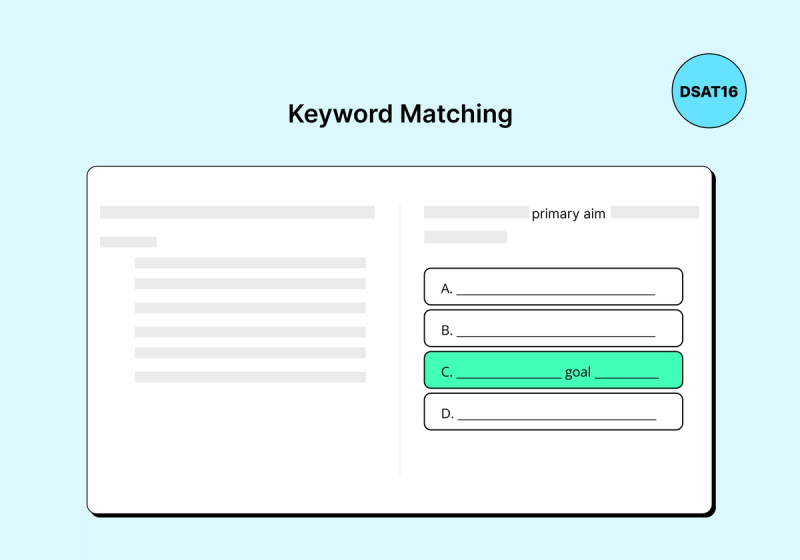
This keyword-matching technique can cut your solving time from 60 seconds down to just 15-20 seconds per question.
Let me show you exactly how this works in practice.
Digital SAT Rhetorical Synthesis Example #6
While researching a topic, a student has taken the following notes.
- The Marshmallow Test was a psychological experiment in 1972.
- It was conducted by Walter Mischel.
- He aimed to investigate children's ability to delay gratification.
- In the experiment, researchers presented the children with 2 choices: eating one marshmallow immediately or waiting 15 minutes for two marshmallows.
- The experiment revealed correlations between children's ability to delay gratification and positive life outcomes.
The student wants to present the method used in the experiment. Which choice most effectively uses relevant information from the notes to achieve this goal?
Select an answer to enable Submit
Scan the question: it asks for “the method” used in the experiment.
Looking at the answers:
- (A) states its objective, using “was conducted to”.
- (B) discusses the result, using “revealed”.
- (C) gives an explanation, using “was a”.
- only (D) clearly stated the method, hence we choose (D) as the correct answer.
Let’s try another one:
Digital SAT Rhetorical Synthesis Example #6
While researching a topic, a student has taken the following notes.
- The shadow theater is a form of entertainment that was invented in China in the 12th century.
- It consists of a screen on which shadows created by puppets are projected.
- The shadow theater is often accompanied by music and storytelling.
- Wayang Kulit is a shadow puppet play originated from Java, Indonesia.
- In Wayang Kulit, the puppeteer uses a gamelan orchestra to set the mood for the story.
The student wants to introduce and provide an example of shadow theater’s connection with music and storytelling. Which choice most effectively uses relevant information from the notes to achieve this goal?
Select an answer to enable Submit
This one is slightly tougher. the question here asks for two aspects: an introduction and an example. Hence, the correct answer needs to provide both.
As a reminder, to scan for an example in the answers, you can look for paraphrase versions like “instance”, “such as”,...
(A) is the correct answer as it accomplishes both goals the student is trying to achieve.
Conclusion
After this blog, Students’ Notes questions, which started out looking long and complicated, should now be a cake walk for you.
You are now equipped with the skills to deal with them, namely skipping the left part and scanning for the right keywords.
Student Notes are indeed the easiest questions in the digital SAT. But because of that, they are also the questions that are worth the most points.
Therefore, prioritize getting these correct 100% of the time before going for the harder ones like Words in Context and Command of Evidence.
One way to do this is with DSAT16 Question Bank, our SAT-practice platform (Shameless plug, I know).