Today, I’m going to teach you everything you need to know about SAT Transitions.
Let’s dive right in.
What are Transitions Questions
In the Digital SAT Verbal section, Transitions questions ask you to pick the most fitting, you guessed it, transition word to fill in the blank.
Transition questions account for 4-8 items per test.
The question will be: “Which choice completes the text with the most logical transition?”
The answer choices consist of 4 grammatically correct options. Therefore, these questions do not test your grammar.
Rather, they test your ability to recognize the relationship between 2 sentences/parts of sentences.
Why are Transitions Important
Aside from answering transitions questions themselves, knowing how to use transitions is extremely important for Reading passages.
If you know how to properly identify transitions, you can use them to determine the relationship between sentences.
This helps you so much with lexical inference and reading comprehension, which are core skills for Words in Context and basically the whole Reading section.
Digital SAT Transitions Example
Below is an example, taken from DSAT16:
Digital SAT Transitions Example #1
To address the challenge of interpreting environmental themes in cultural texts, scholars have developed specific analytical frameworks. ______ literary critic Lawrence Buell proposed a set of criteria to define an “environmentally oriented work.” Buell’s framework helps to identify and analyze texts that exhibit a strong connection to the natural world, moving beyond simplistic representations of nature.
Which choice completes the text with the most logical transition?
Select an answer to enable Submit
As always, remember to identify the clauses that the transition connects:
- “To address the challenge of interpreting environmental themes in cultural texts, scholars have developed specific analytical frameworks.”
- “literary critic Lawrence Buell proposed a set of criteria to define an ‘environmentally oriented work.’”
These two clauses demonstrate a causal relationship. The first clause presents a problem or need (the challenge of interpreting environmental themes), and the second clause provides a specific solution or response to that challenge (Buell’s proposed criteria). The second clause is a direct result of the situation described in the first clause.
When we need to connect clauses in a cause-and-effect relationship, we use causal transitions. Among the answer choices, only (C) “For this reason” is a causal transition that logically connects these ideas. It effectively signals that Buell’s framework was developed because of the challenge mentioned in the first sentence.
The correct answer is (C).
Now that you understand how Transitions questions look like, it’s time to go through the tips and tricks to handle them.
#1: The 3 Types of Transitions
Your first step is to understand and categorize transitions. This is because if you don’t know what a transition word does, you won’t be able to use it properly.
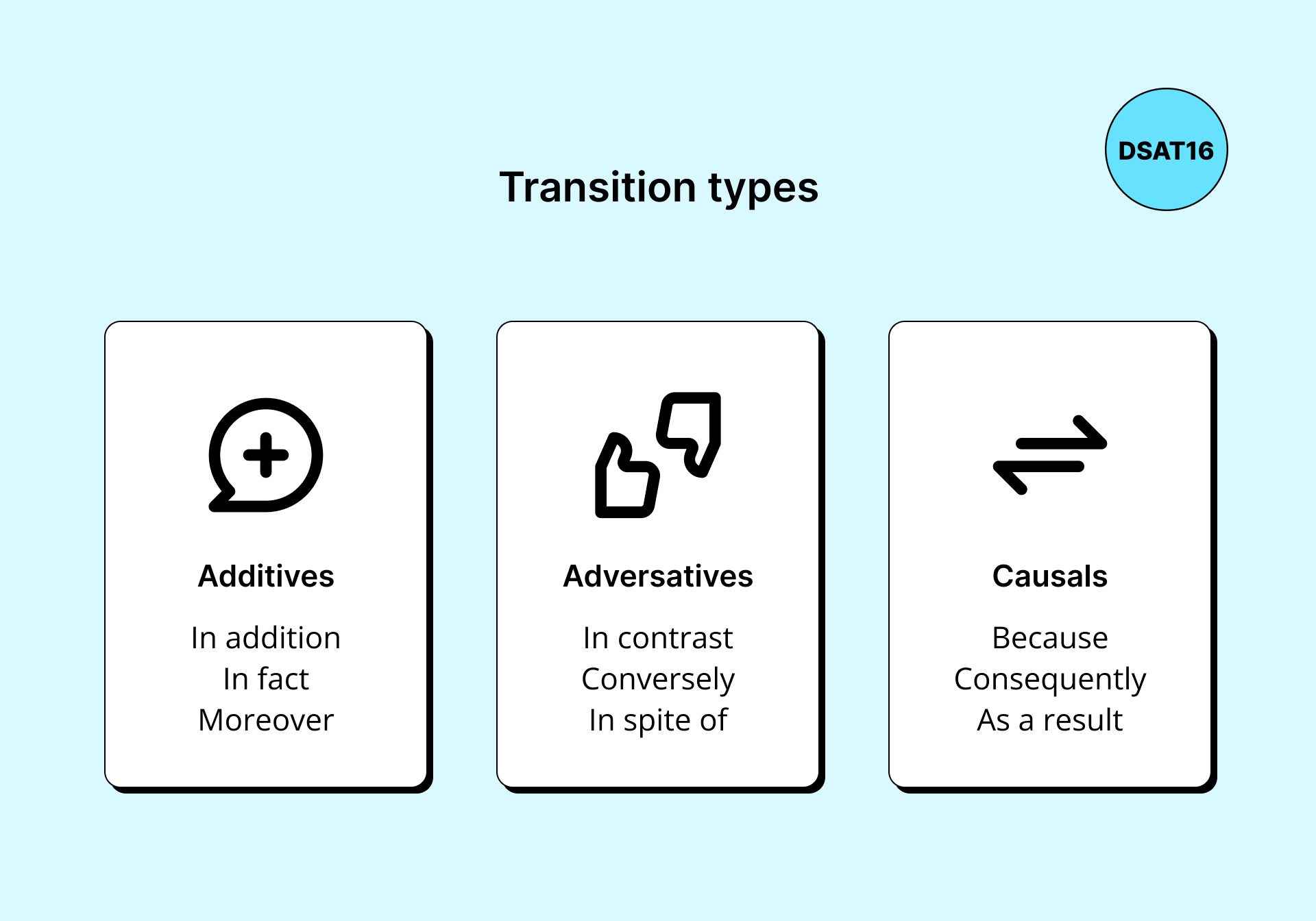
There are 3 main types of Transitions: Additive, Adversative, and Causal.

.png?w=800&auto=format "Guide to Transition Types in English Writing: Additives, Adversatives, & Causals (DSAT16)")
Additive
Additive transitions connect ideas that build upon each other. They signal that you're adding more information, providing examples, or continuing a similar line of thought.
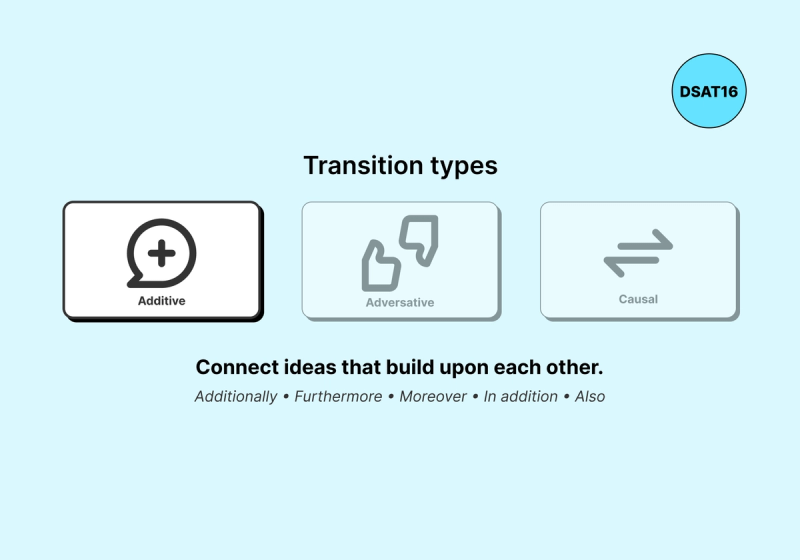
Common Additive Transitions include:
- Additionally
- Furthermore
- Moreover
- In addition
- Also
- Likewise
- Similarly
Adversative
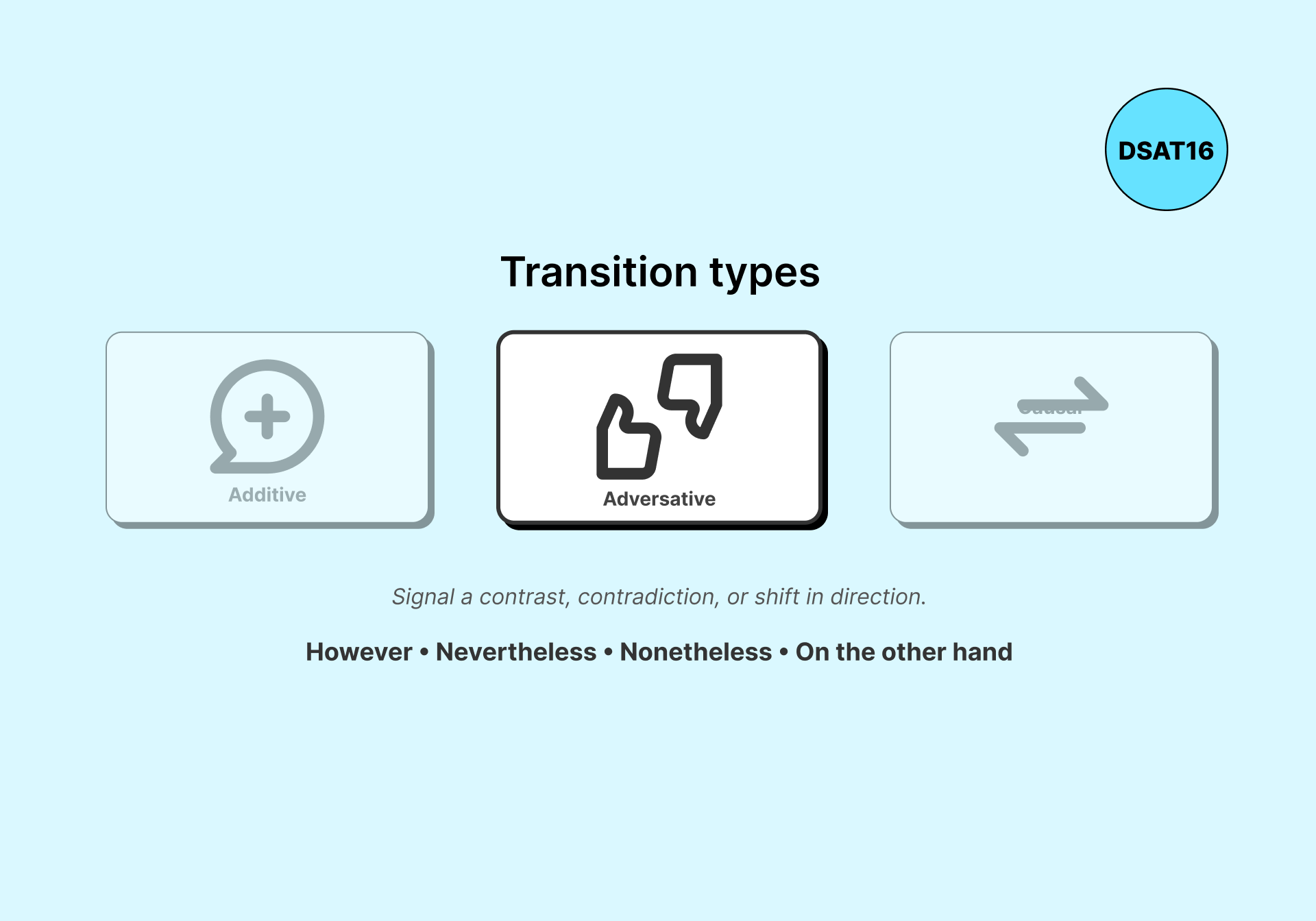
Adversative transitions signal a contrast, contradiction, or shift in direction. They tell the reader that what comes next will challenge, oppose, or differ from what was just said.
.png?w=800&auto=format "Understanding Adversative Transition Words in English Grammar (DSAT16)")
Common Adversative Transitions include:
- However
- Nevertheless
- Nonetheless
- On the other hand
- In contrast
- Conversely
- Although
- Despite
- Yet
- But
- Still
- Even so
Causal
Causal transitions show cause-and-effect relationships. They explain why something happened, what resulted from an action, or the logical consequence of a statement.
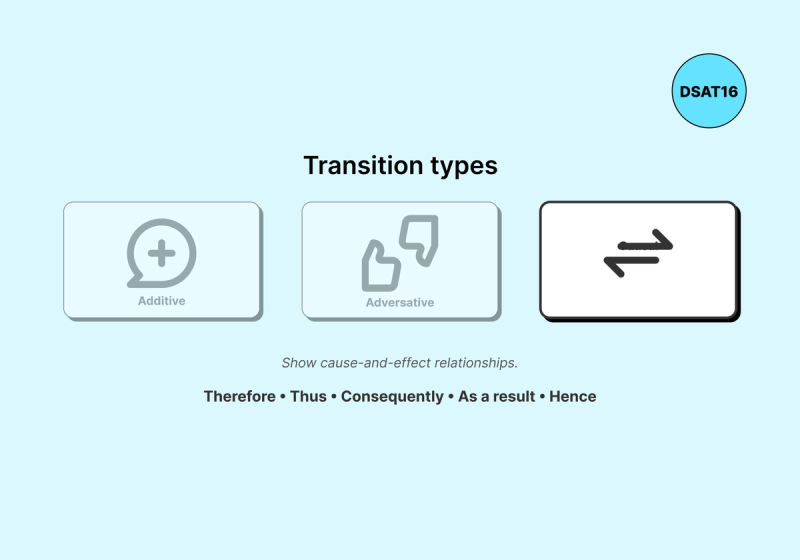
Common Causal Transitions include:
- Therefore
- Thus
- Consequently
- As a result
- Hence
- Accordingly
- So
- Since
- Due to
Now that you know the 3 types of transitions, let's move on to the exact method you'll use to solve these questions.
Other Transitions
Beside the three types of transitions mentioned above, there are other transitions that appear in the test.
Another big group is sequential transitions, which indicate a sequence or order of events, ideas, or steps in a text. These include:
- First
- Second
- Later
- Subsequently
Functionally, they are similar to additives, as in they are used to introduce something that adds to the previous point.
There are still many more other transitions. Below are the brief explanations for some that appeared in the Bluebook practice tests. Note that these transitions often (not always) appear in incorrect choices:
- In comparison/ By comparison – to provide comparison (Can be both additive and adversative).
- Currently, Today, Nowadays – to describe the situation lately.
- Elsewhere – to refer to another place or location.
- There – to point to a specific location or indicate a particular point in time.
- Increasingly – to indicate a growing trend or a change that is becoming more prevalent over time.
Overall, you should not fret over these transitions that much. They are not likely to appear in the test. If they do, it’s usually pretty obvious whether they are correct or not.
#2: The 5-step framework
As with any other question type, the best way to tackle them is with a systematic approach.
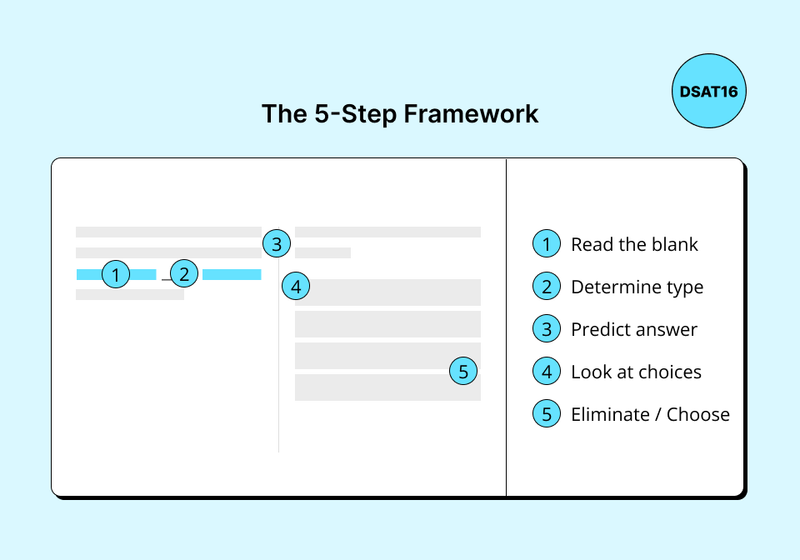
So, here is the exact 5-step framework I use to solve every Transitions question correctly:
- Read the clause containing the transition and the clause before that.
- Determine the relationship between them (i.e. transition type).
- Predict the answer.
- Look at the answer choices and pick the choice that matches your prediction.
- if you can’t, eliminate obviously wrong answer choices.
It is extremely important that you try to predict the correct answer before looking at the options.
If you don’t do this, you might see a choice that is kinda right but not really and start justifying it (we all did this at some point).
This strategy is actually not just for Transitions. It is also effective for any other question type, especially the harder ones like Inferences.
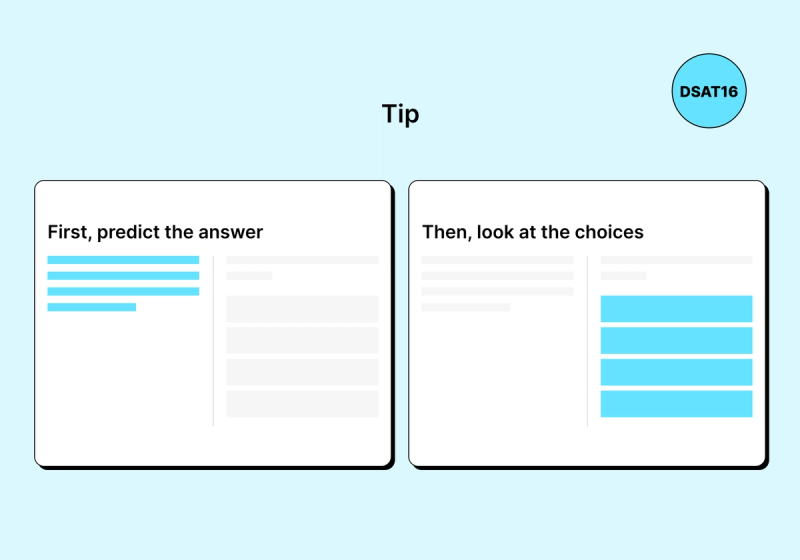
Let’s try an example:
Digital SAT Transitions Example #2
It is widely accepted that all known life on Earth descended from a single common ancestor. ______ based on the premise that our detection methods are biased towards familiar biology, philosopher of science Carol Cleland has argued for a hypothetical ‘shadow biosphere’. This would consist of microbial life that represents a second, independent origin of life with a fundamentally different biochemistry.
Which choice completes the text with the most logical transition?
Select an answer to enable Submit
As always, remember to identify the clauses that the transition connects:
- ‘It is widely accepted that all known life on Earth descended from a single common ancestor.’
- ‘based on the premise that our detection methods are biased towards familiar biology, philosopher of science Carol Cleland has argued for a hypothetical ‘shadow biosphere’. This would consist of microbial life that represents a second, independent origin of life with a fundamentally different biochemistry.’
The first clause presents the widely accepted scientific view that all life shares a single common ancestor. The second clause introduces Carol Cleland’s contrasting argument for a 'shadow biosphere’—life with a completely different, independent origin.
These clauses present contrasting ideas. The first describes the conventional, accepted view of life’s singular origin, while the second challenges this by proposing the possibility of a separate, independent origin of life with different biochemistry. This is a clear adversative relationship.
Therefore, we need an adversative transition. (D) “However,” is the correct answer as it effectively signals this shift from the established scientific consensus to an alternative hypothesis that contradicts it.
Now that you've got the framework down, let's look at a quick trick that can instantly eliminate half your answer choices.
#3: Eliminate Synonyms
This one is obvious.
Because there can only be 1 right answer, if there are 2 or more synonyms in the choices, you can eliminate both.
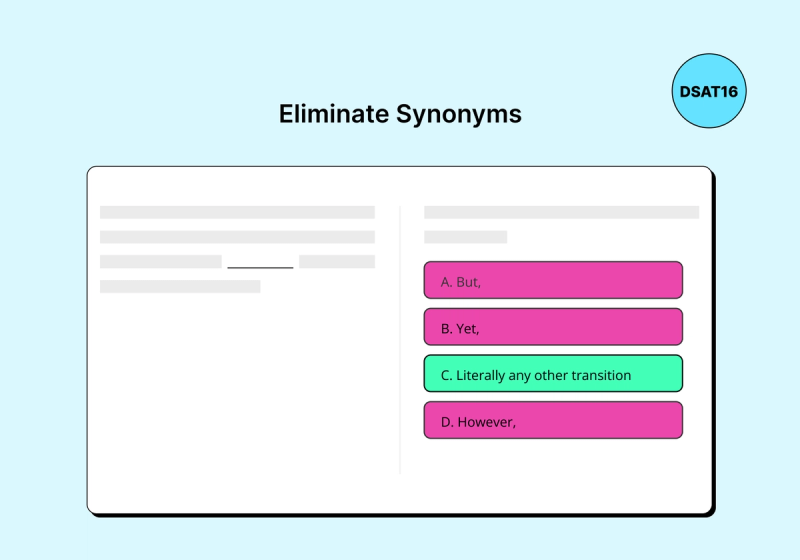
Let’s try an example, adopted from a NY Times article:
Digital SAT Transitions Example #3
Over the years, medical schools have made some progress in diversifying their student bodies, with numbers ticking up. But just like undergraduate admissions, wealth and connections continue to play a determining role in who is accepted. ______ more than half of medical students come from families in the top 20 percent of income, while only 4 percent come from those in the bottom 20 percent.
Which choice completes the text with the most logical transition?
Select an answer to enable Submit
Here you can see (B), (C) and (D) are all Causal transitions and can be used somewhat interchangeably. Since there can only be one correct answer, we can eliminate these three. (A) is the correct answer.
That example was kind of an exaggeration. For most questions, it’s not gonna be that easy.
Still, It’s a good tip to keep in mind to save some time.
#4: Distinguishing Similar Transitions
On hard questions, you will sometimes have to make fine distinctions between 2 transitions of the same type.
Digital SAT Transitions Example #4
For more than 2,000 years, Euclid’s text was the paradigm of mathematical argumentation and reasoning. _______ by the 20th century, mathematicians were no longer willing to ground mathematics in this intuitive geometric foundation. Instead, they developed formal systems — precise symbolic representations, mechanical rules.
Which choice completes the text with the most logical transition?
Select an answer to enable Submit
Following the 5-step framework, these are the two clauses:
- “For more than 2,000 years, Euclid’s text was the paradigm of mathematical argumentation and reasoning.”
- “by the 20th century, mathematicians were no longer willing to ground mathematics in this intuitive geometric foundation.”
These clauses present contrasting ideas, which means we will need an Adversative transition. This is where we need to make fine distinctions between (B) and (C).
"However" is more commonly used and generally introduces a contrast between two ideas without implying a strong counterargument. It's often used to present a shift or unexpected result.
"Nevertheless" introduces a contrast as well, but it also carries a connotation of acknowledging a counterargument or opposing viewpoint. It's used to emphasize that despite what was mentioned in the first sentence, the second sentence's information still holds true.
(C) is the correct answer.
#5: Transition Placement
This one is kinda confusing.
If the transition is placed at the middle or end of the sentence, you must determine whether it is used to connect two sentences or two parts of a sentence.
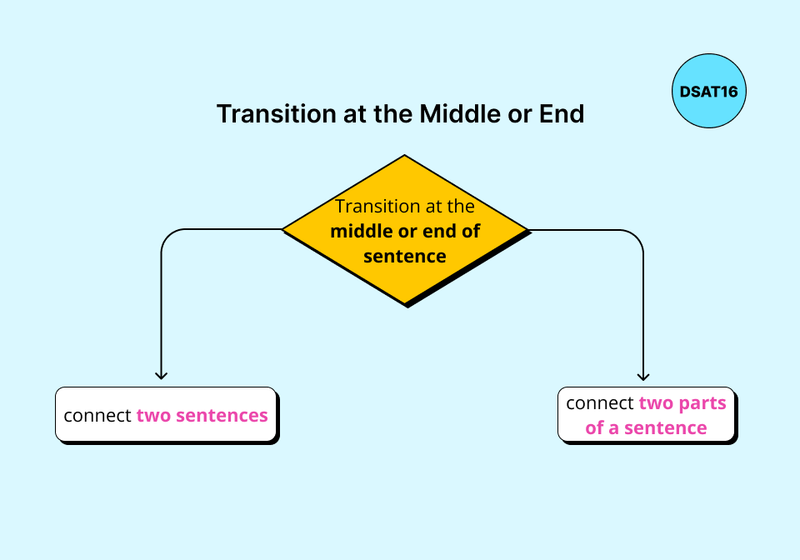
Let’s have a look at an example where the transition is in the middle of a clause, or more specifically, lies between the subject and the predicate.
Digital SAT Transitions Example #5
Technology has undoubtedly transformed communication, allowing people to connect instantly across vast distances. This convenience, ______ comes at the cost of reduced personal interaction and potentially diminished social skills. With the advent of digital communication methods, it is crucial to strike a balance between the benefits of technology and the importance of meaningful face-to-face connections.
Which choice completes the text with the most logical transition?
Select an answer to enable Submit
Here you’ll find that the transition links the clause it is in and the clause before that:
- “Technology has undoubtedly transformed communication, allowing people to connect instantly across vast distances.”
- “This convenience, ______ comes at the cost of reduced personal interaction and potentially diminished social skills.”
These clauses are opposing statements. Hence, we need an Adversative transition. Only (D) fits the bill here.
Now, let’s see the same example but with the transition at the end of the sentence.
Digital SAT Transitions Example #6
Technology has undoubtedly transformed communication, allowing people to connect instantly across vast distances. This convenience comes at the cost of reduced personal interaction and potentially diminished social skills, ______. With the advent of digital communication methods, it is crucial to strike a balance between the benefits of technology and the importance of meaningful face-to-face connections.
Which choice completes the text with the most logical transition?
Select an answer to enable Submit
Many will think the clauses linked by the transition will be on its two sides.
However, when a transition is used to connect 2 sentences, it will always connect the sentence that contains it and the sentence before it.
Placing the transition at the start, middle, or end of a sentence is grammatically changeable.
So, for this question, the answer is still (D).
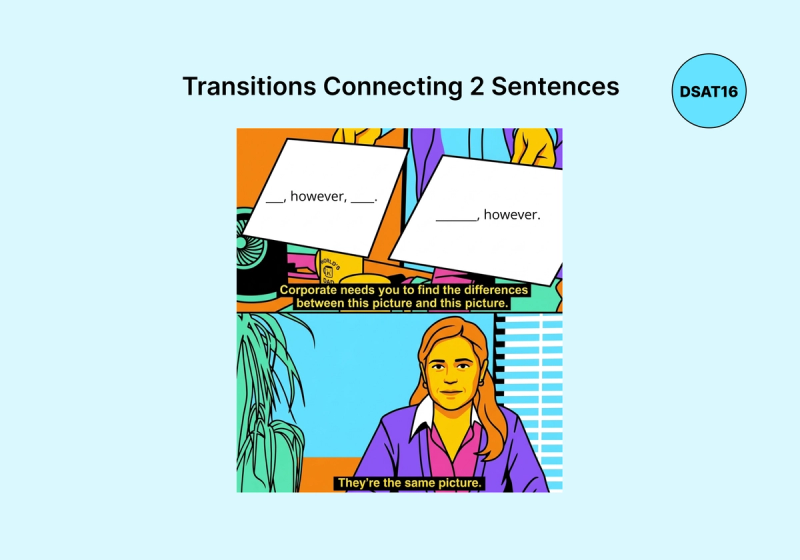
Oftentimes, the transition is used to link two parts of the same sentence:
Digital SAT Transitions Example #7
Shadows enhance realism, ______ they are difficult to depict. Therefore, painters interested in shadows must move one step at a time, by trial and error, testing the limit of the tolerance of the visual brain.
Which choice completes the text with the most logical transition?
Select an answer to enable Submit
The information around the blank contradicts each other. Therefore, an adversative should be used.
(C) is the only adversative here: (A) is an additive while (B) and (D) are causals.
Conclusion
Hopefully, thanks to this guide, you can now ace every single Transitions questions.
While Transitions are on the easier side of the digital SAT, you should still put some time into mastering it.
First of all, even a single mistake can cost you valuable points. This is especially true for easier questions. Remember, easier questions worth more points than harder ones.
Second, paying attention to transitions can help a lot with reading comprehension, which you will need for those tough questions like Inference and CoE.
Now you have everything you need for this. It’s time for you to practice, hopefully with DSAT16.