Recently, Google Gemini announced their own SAT practice test feature, allowing students to prepare for the exam directly within the Gemini interface.
As someone who uses AI to create my own question bank, I know that it’s really hard and requires a lot of tooling to make the questions as close to the real tests as possible.
So, I decided to mess around with Gemini to see if the questions (and interface) are legit or not.
To get your free SAT practice test, enter the prompt “I want to take an SAT practice test“ into Gemini. There will be a pop up window on the right like in the picture. Note that you can do this for as many times as you want.
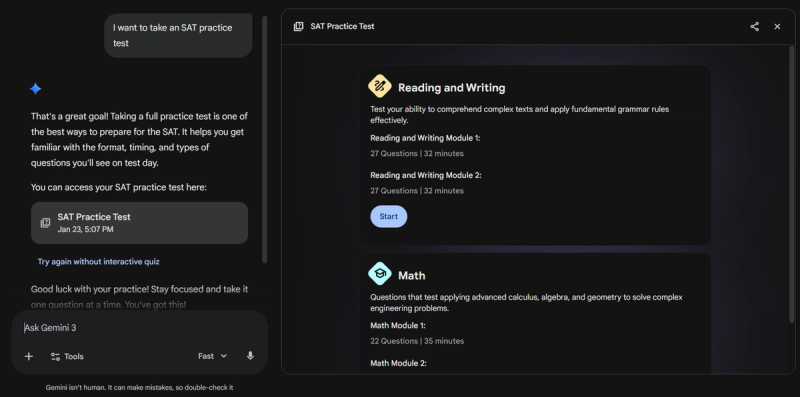
Once you click "Start" on the Reading and Writing module, you'll be taken through a series of questions that simulate the actual SAT format.
Basically, now you have unlimited practice tests (not quite, but more on that later). After testing its features extensively, here are my thoughts on it.
As with everything, Gemini has its own pros and cons. First, let’s explore the good things about it.
From my testing, the quality of the questions is really good and mirrors the actual SAT test. The test I got has all the question types that the real test would have.
Furthermore, they all followed the same “SAT-style” logic, and the answer choices also featured the same common traps in the SAT.
However, there are a few minor differences.
Firstly, there might be a few questions that are a bit unique. Take a look at this one:
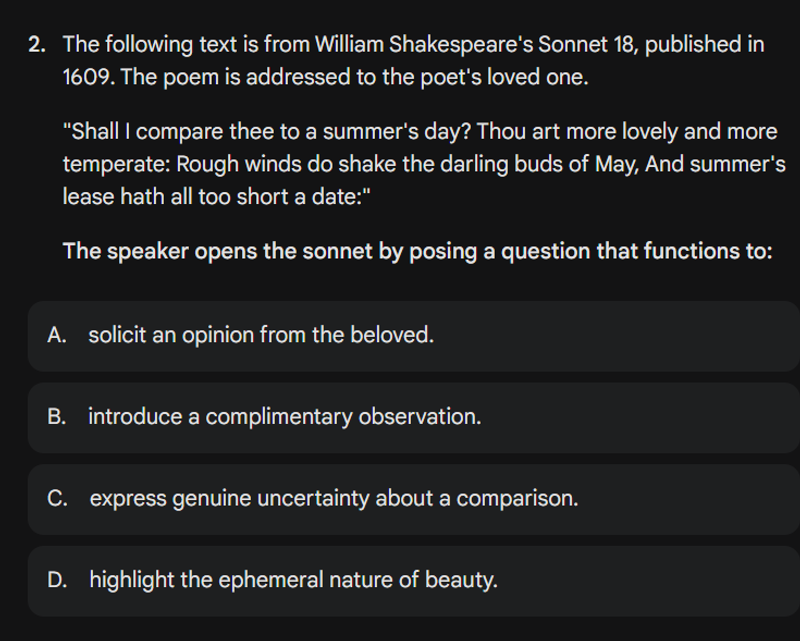
Usually, the question would be “Which choice best states the function of the underlined sentence in the text as a whole?“, with the first sentence of this passage underlined.
I said this is minor because at the end of the day, both versions asked for the same stuff and test the same skills. However, just know that the phrasing will be different in the actual SAT exam.
Secondly, the “vibe” of the questions are more modern and mainstream.
In the actual digital SAT, the studies and fiction novels featured in the questions are less known and often older, whereas the Gemini questions are usually about popular media and researches.
For example, in the actual SAT, you might encounter a passage about a 19th-century naturalist's observations on bird migration patterns, or an excerpt from an obscure 1920s short story by a lesser-known author.
In contrast, the Gemini practice test featured questions about:
- Victor Hugo’s Les Misérables (an extremely popular novel)
- A study on AI and LLMs (guess I don’t need to explain how mainstream this is)
- Weirdly enough, Naruto and One piece.
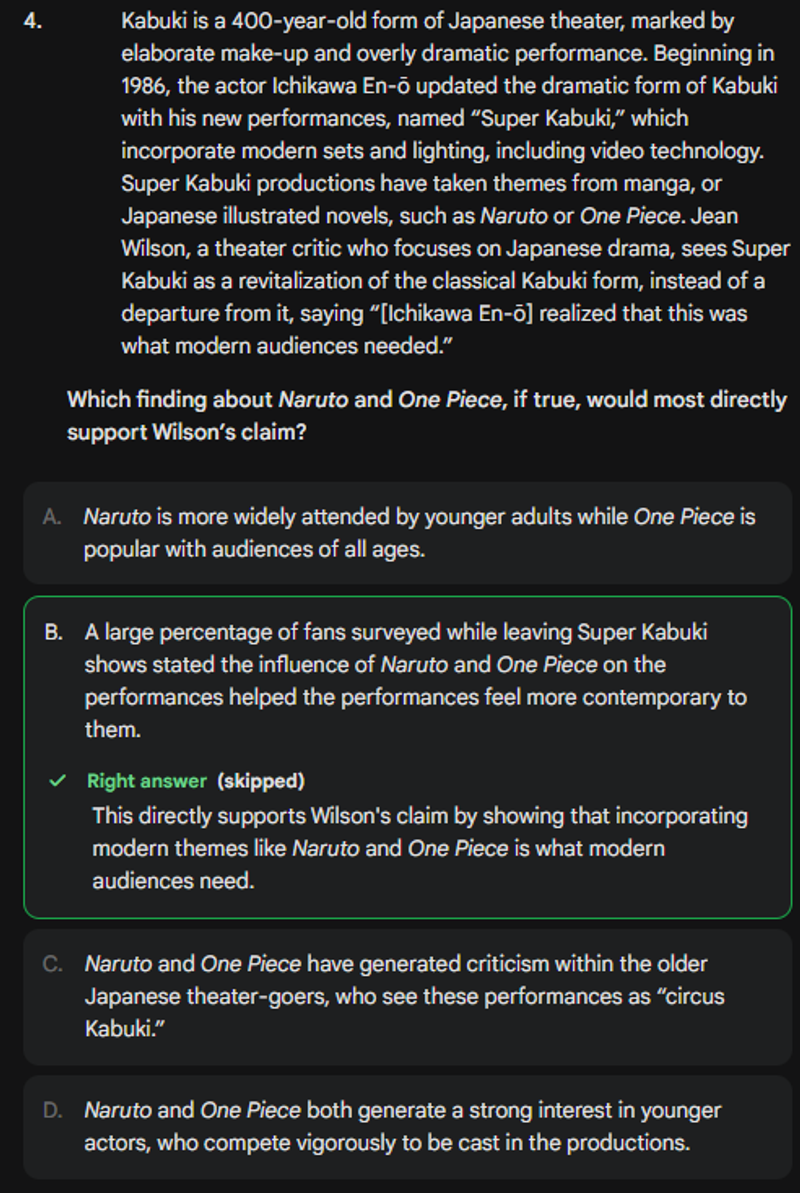
This different will affect the difficulty of the questions, as studies have shown that reader’s familiarity with the topic directly correlates with reading comprehension.
So, you should be prepared for the actual SAT to feel slightly more "academic" and feature more obscure source material.
I spent the whole 2025 to generate SAT questions with AI. It was hard.
I could probably say “give me an SAT question”, use whatever slop the AI spit out and upload it on DSAT16.
But I didn’t want to do that.
So, I spent a lot of time to tinker with AI and make it feel like the real SAT. As close as possible.
In my experience, the ones that were the hardest to generate are:
- Punctuations, because AI are used to non-academic writing (for example, using a colon above is technically wrong).
- Fiction, because AI can’t give a verbatim quote of any novel.
- and Graphs, because AI tend to hallucinate data. They were also pretty bad at drawing at the time.
Naturally, I paid extra attention to these questions when I test the Gemini versions.
And I was pleasantly surprised.
The punctuation questions felt authentic and followed proper academic conventions.
The fiction passages were also impressive. Gemini appears to have access to actual literary excerpts.
The passage from Victor Hugo’s Les Misérables (shown below) was quoted verbatim.
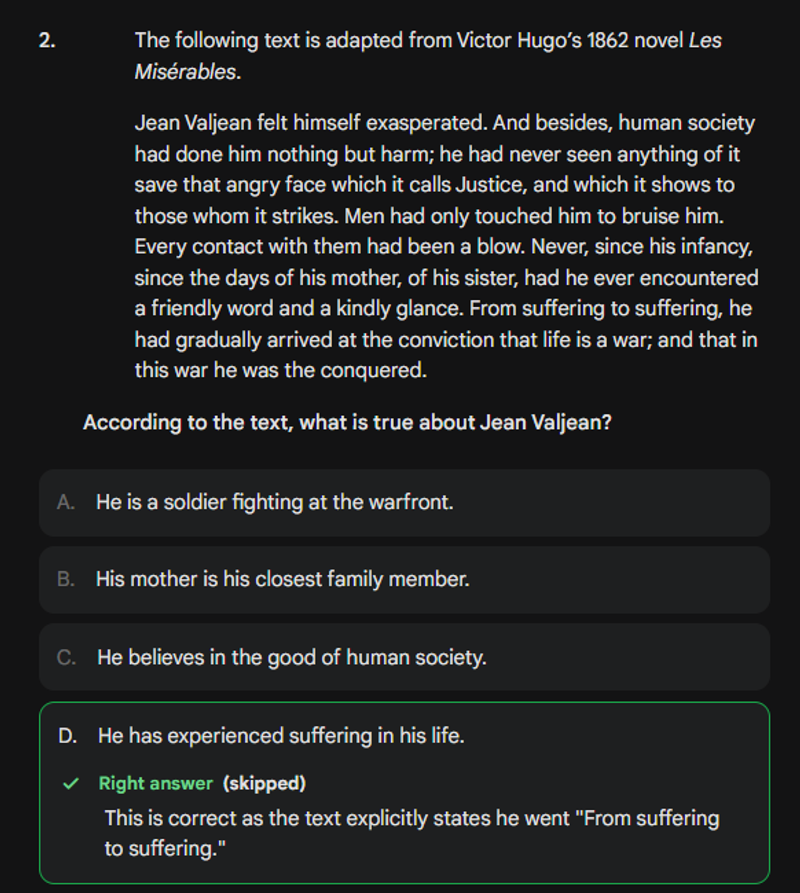
Most surprisingly, the graph questions were also well-constructed. The data visualizations were clear, properly labeled, and the questions tested genuine data interpretation skills rather than simple reading of values.
Overall, if these questions are AI-generated, Google has done an exceptional job making them indistinguishable from human-written SAT content.
But I doubt that was the case. I googled the question above, and I found it on a random website. Most likely, the Gemini team curated these questions.
I checked further, and seems like a lot of graph questions are reused as well. Makes sense, since they are really hard to generate.
While the question quality impressed me, the Gemini SAT practice test isn't without its drawbacks. Let's look at the areas where it falls short.
In the actual test, the order of the questions are always the same.
The actual SAT follows a consistent structure: you start with vocabulary questions, move through reading comprehension (main idea and main purpose), then tackle inference and command of evidence, and finally finish with writing questions.
The Gemini test, however, presents questions in a seemingly random order. In my test, the first question was main purpose, followed by a paired passage question.
Words in context didn't appear until the sixth question, and after several transitions questions, another vocabulary question popped up unexpectedly.
This inconsistent ordering means you won't get an accurate sense of the test's pacing and flow, which could throw you off on exam day.
This is especially important, as a popular strategy for international students is to do the writing part first, then go back to reading.
Well, you can see the problem for them if reading and writing were jumbled up together.
The real digital SAT is adaptive.
This means that if your performance in module 1 is good, you get a harder module 2, but a better “curve” and ceiling. In contrast, module 2 will be more forgiving if you fumbled the 1st module.
The test by Gemini, on the other hand, is purely non-adaptive.
The 2nd module seems like will always be just slightly harder than the 1st.
Overall, for something like the r/SAT community, I don’t think this matters that much. Feels like everyone here got to the hard module 2 and scored 1500+.
Jokes aside, for students who are just starting, immediately getting a harder module 2 might feel overwhelming and demotivating.
While having SAT practice built into Gemini sounds convenient, the actual integration is kinda bad.
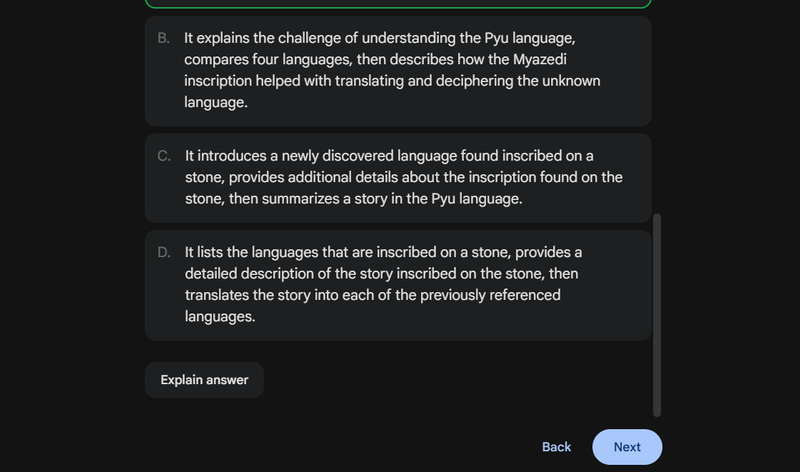
The biggest issue is that Gemini doesn't have context of the full question when you're asking for help.
If you're stuck on a problem and want an explanation, you'll need to manually copy and paste the entire question, passage, and answer choices into the chat.
This is extremely inconvenient and disrupts your flow during practice.
Additionally, this copy-paste approach burns through your usage tokens quickly.
I used the Pro version on a free tier and hit the limit after 2 questions. For the Fast version, I’m guessing Gemini can only answer 10-15 questions before you hit your usage limit.
For a full practice test with 98 questions across all modules, this is a significant limitation.
Those who want to use Gemini as a tutor alongside the practice test will either need to upgrade to a paid plan or carefully ration their questions-neither of which is ideal for a feature marketed as "no-cost practice”.
This one is a bit nit-picky.
In Bluebook, you get a tool called “Annotate“ for the Verbal sections and DESMOS for the math sections.
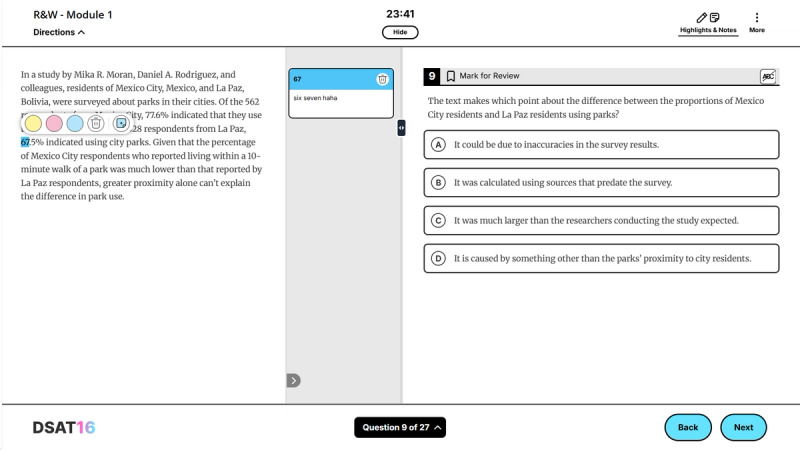
Gemini's practice test lacks these essential tools entirely.
While these missing features don't affect the quality of the questions themselves, they do mean you won't be practicing with the same tools you'll have on test day, which could impact your comfort level and efficiency during the actual exam.
Despite these interface limitations, the lack of these tools shouldn't be a dealbreaker for most students. There’s always a mildly inconvenient work-around for them.
For annotation, you can simply use a separate note-taking app or even pen and paper to jot down key points as you read passages.
For math questions, you can access DESMOS directly through their website in another tab.
Google's Gemini SAT practice test is a solid free resource with genuinely high-quality questions that closely mirror the actual exam. The question content itself is well-written and testing the right skills.
However, the execution has some notable flaws.
The randomized question order doesn't match the real test structure, the non-adaptive format means you won't experience the actual SAT's difficulty scaling, and the clunky Gemini integration makes it frustrating to get help on questions you're struggling with.
So, is it worth using?
Definitely.
Aside from the fact that it’s free, simply having a bunch of SAT questions to practice with is incredibly valuable for building familiarity with question types and improving your skills.
However, if you want to prepare for the actual test experience. Gemini is not the best tool for this. You are better off using Bluebook or another platform with a full-fledged interface.
In my opinion, Gemini is best suited for studying individual questions rather than simulating a full mock test experience.
Use it to drill specific question types, understand answer explanations, and build familiarity with SAT-style logic
But when it comes to replicating the actual test-day conditions, stick with Bluebook or find a dedicated practice platform.