P/S: Looking for a SAT Vocab List instead? Just click the link.
What are SAT Words in Context Questions?
In the Digital SAT, Words in Context test students' ability to infer the meaning of a word based on the surrounding contextual clues.
There are 2 types of Words in Context Questions:
- Fill-in-the-blank: The provided passage will have 1 word replaced with a blank (______). Your job is to pick the answer choice that is most suitable to (you guess it) fill in the blank.
- Fiction: For this one, you will be given a passage adapted from a novel or play. One word in the passage will be underlined. The question will ask you to choose the answer choice that is closest in meaning to the underlined word.
Importance of Words in Context Questions
The ability to understand a word using context clues (also known as Lexical Inference) is crucial for other SAT reading questions as well. Memorizing vocabs will not be enough.
By preparing for Words in Context questions, you are also honing your Lexical Inference skill.
How to Approach Vocabulary Questions
I recently wrote a comprehensive guide on Words in Context. If you want something more in-depth, please check it out. Otherwise, below is a short summary.
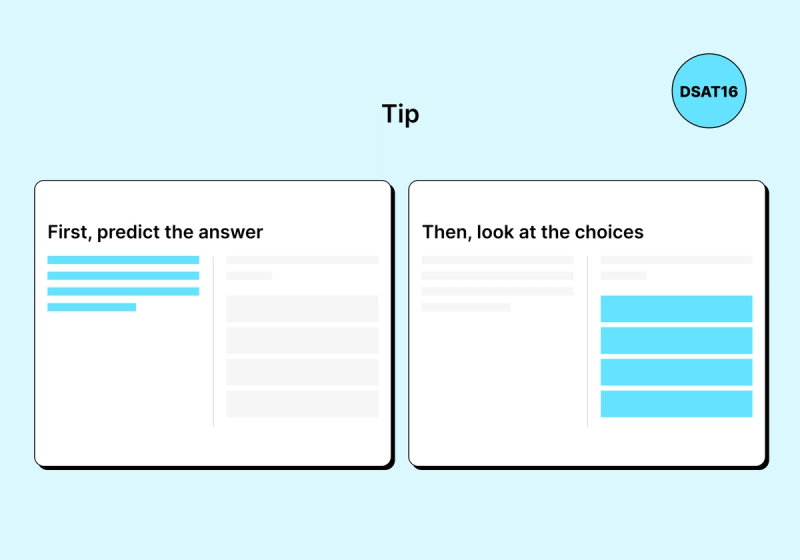
1. Try to predict the correct answer before looking at the answer choices.
As with other question types, you should always try to come up with your own answer before reading the 4 answer choices.
This way, by the time you look at the choices, you already have a vague idea of what the correct choice look like.

2. Pay attention to context clues
Surrounding texts can give you a huge hint on what the meaning of the answer choice might be.
So, pay attention to punctuations (especially colons), Contextual Paraphrased Versions, transitions, as well as the overall passage tones to determine the correct choice.
3. Understanding the correct answer
If you understand all of the answer options, you should be good to go.
However, if you are not, you can always rely on Word Blocks, such as root words, prefixes, and suffixes, to make an educated-guess.
Also pay attention to second meanings, as answer options with uncommon second meanings are often the correct answer.